

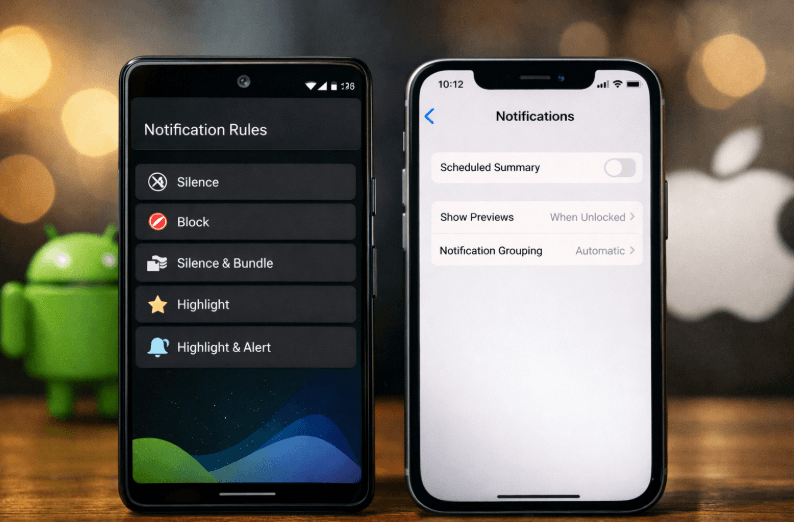
Android could soon take another step ahead of Apple’s iOS in one of the most competitive areas of smartphone usability: notification management. New details uncovered in a recent beta release suggest Google is working on a feature that would give users far more precise control over how alerts appear—and when they don’t.
Granular Notification Controls in Development
Code discovered in Android 17 Beta 3 points to a feature called “Notification rules,” designed to let users customize how notifications behave for specific apps and individual contacts. The feature appears to go beyond existing tools by offering a more tailored, rule-based system.
According to the findings, users will be able to assign one of five actions to notifications:
Key Notification Actions
- Silence: Deliver notifications quietly without sound or vibration
- Block: Prevent notifications from appearing entirely
- Silence & Bundle: Group notifications together and mute alerts
- Highlight: Prioritize certain notifications visually
- Highlight & Alert: Emphasize notifications with sound or vibration
This level of control could help users better manage the growing volume of alerts from messaging apps, social media, and work-related tools—an issue that has become increasingly relevant in the always-connected U.S. lifestyle.
Not Limited to Pixel Devices
The feature may not be exclusive to Google’s Pixel lineup. Early traces of “Notification rules” have also appeared in leaked builds of Samsung’s One UI 9, suggesting broader adoption across Android manufacturers.
If confirmed, this would align with Android’s ecosystem approach, where major platform features are often integrated into custom interfaces from companies like Samsung, giving them additional reach across global markets.
Android’s Ongoing Advantage Over iOS
Android has long held a reputation for offering more flexible notification management compared to Apple’s iOS. Features such as:
- Notification Channels (allowing per-category controls within apps)
- Notification Cooldown (reducing alert fatigue from repeated notifications)
- Focus Modes and system-wide Modes
- Notification Organizer (recently introduced to streamline alerts)
have made it easier for users to sort, filter, and prioritize incoming information.
In contrast, while iOS has improved in recent years with features like Focus filters and scheduled summaries, it still offers fewer customization options at a granular level—particularly when it comes to handling notifications from specific contacts or apps differently.
A Step Toward Smarter Digital Boundaries
The introduction of “Notification rules” reflects a broader industry trend: giving users better tools to manage digital interruptions. In a work culture where smartphones often double as both professional and personal hubs, the ability to fine-tune alerts can help reduce distractions and improve productivity.
For example, a user could highlight urgent messages from a supervisor while silencing group chats or promotional app notifications during work hours—without manually adjusting settings throughout the day.
What Comes Next
Google has not officially announced the feature, and it remains unclear whether “Notification rules” will ship with the final release of Android 17. However, its presence in both beta code and third-party interface leaks suggests active development and strong potential for rollout.
Conclusion
If implemented as expected, “Notification rules” could reinforce Android’s lead in notification management by offering users unprecedented control over how they receive information. As smartphones continue to play a central role in daily life, features like these may become essential—not just convenient—for maintaining focus and balance.