
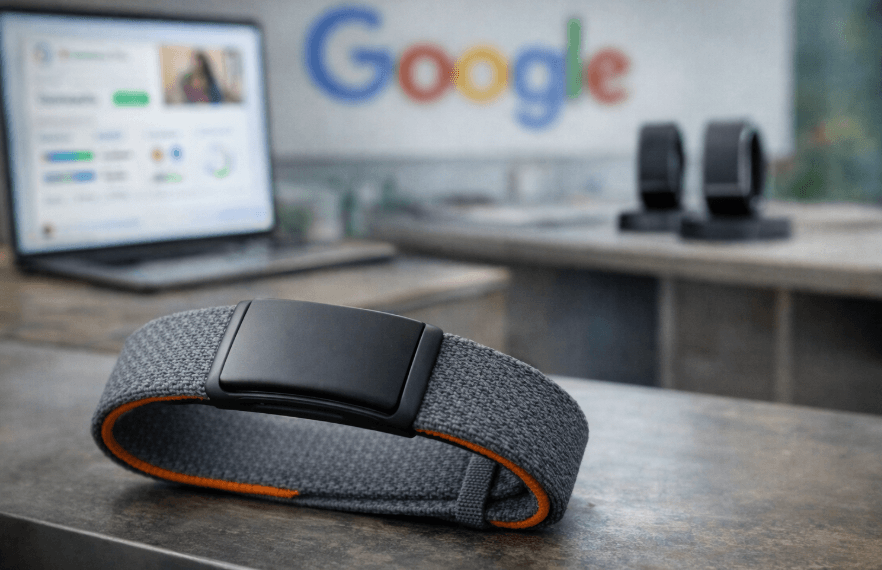
Google is moving deeper into the fast-growing wearable fitness market, developing a new screenless Fitbit device designed to compete with subscription-based trackers from rivals like Whoop and Oura. The effort signals the tech giant’s push to expand its health ecosystem as demand for minimalist, data-focused wearables continues to rise in the United States and globally.
Google Targets Subscription Fitness Wearables
Alphabet Inc.’s Google is building a new fitness band under its Fitbit brand, according to a person familiar with the project. The device is expected to launch later this year and will compete directly with screenless wearables from Whoop Inc. and Oura Health Oy.
Unlike traditional smartwatches, the upcoming Fitbit band will not include a display. Instead, it will focus on passive health tracking, with users accessing insights through a companion app.
The device will reportedly offer basic features out of the box, while more advanced capabilities will require a paid subscription—mirroring the business model popularized by Whoop and increasingly adopted across the U.S. fitness tech industry.
AI Health Coaching at the Core
A key component of the new product will be its integration with an AI-powered personal health coach built into the redesigned Fitbit app. The feature, which entered public preview in October, provides personalized insights on metrics such as sleep, recovery, activity levels, and overall wellness.
The AI coach is part of Google’s broader push into health data and machine learning, an area where U.S. consumers have shown growing interest, particularly as preventive health and at-home monitoring gain traction.
Fitbit recently expanded its app capabilities to include cycle tracking, mental health insights, nutrition guidance, and hydration monitoring—features aimed at offering a more comprehensive view of personal health.
Athlete Endorsement Signals Strategic Push
Stephen Curry, a star guard for the Golden State Warriors, hinted at the upcoming device in a social media post earlier this week. While he did not reveal specific details, Curry described the product as enabling a “new relationship with your health.”
Google confirmed that Curry has been collaborating with its team, suggesting a marketing strategy that leans heavily on athlete partnerships—an approach that has proven effective for competitors like Whoop, which counts elite athletes among its ambassadors.
Design and Business Model
The new Fitbit band is described as a gray fabric strap with orange accents, closely resembling Whoop’s current screenless design. However, Google is expected to charge upfront for the hardware in addition to the subscription, unlike Whoop, which bundles device access entirely into its membership fees.
This hybrid model may appeal to U.S. consumers who are accustomed to paying for devices outright but are increasingly open to subscriptions for premium digital services.
Intensifying Competition in Wearables
The launch would further expand Google’s wearable portfolio, which already includes the Pixel Watch and traditional Fitbit devices with screens. The move comes as competition in the wearable market intensifies, with companies exploring different form factors and pricing strategies.
Meanwhile, Whoop continues to gain momentum. The company recently raised $575 million in funding from investors including high-profile athletes such as Cristiano Ronaldo, LeBron James, Rory McIlroy, and Reggie Miller. The funding round valued Whoop at approximately $10.1 billion, with plans for a potential initial public offering within the next two years.
Apple Maintains a Different Approach
While Google and its competitors experiment with screenless designs, Apple Inc. continues to focus on full-featured smartwatches. The Apple Watch lineup includes multiple models equipped with displays, emphasizing on-device interaction alongside health tracking.
This divergence highlights a broader split in the wearable market: screen-based devices that function as mini-computers versus minimalist trackers designed for continuous, distraction-free monitoring.
Conclusion
Google’s upcoming screenless Fitbit band underscores a strategic shift toward subscription-driven health technology and AI-powered insights. As competition heats up among major players and startups alike, the success of the device may hinge on how well it balances hardware pricing, subscription value, and user experience in an increasingly crowded U.S. wearable market.