
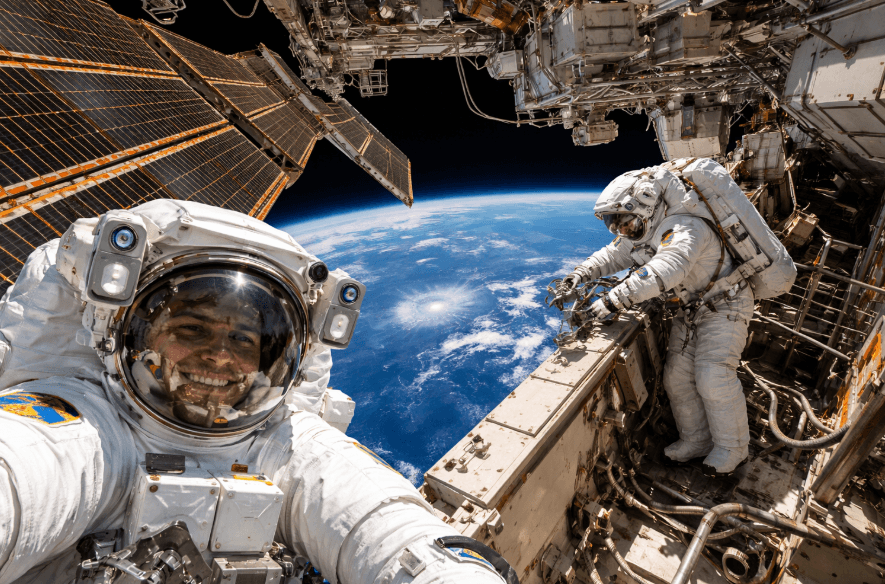
NASA has unveiled a new set of dramatic images captured during its most recent spacewalk outside the International Space Station (ISS), offering a rare glimpse into the high-risk, high-precision work that keeps the orbiting laboratory running.
The photos, taken during a March 18 mission, highlight both the technical complexity of space station maintenance and the human side of exploration as astronauts work hundreds of miles above Earth.
Astronauts Complete Critical ISS Upgrade Mission
During what NASA designated as U.S. spacewalk 94, astronauts Jessica Meir and Chris Williams exited the station through the Quest airlock to prepare a key power channel for future upgrades.
The seven-hour, two-minute spacewalk focused on installing hardware needed for new solar arrays that will enhance the station’s power capacity. These upgrades are part of NASA’s broader effort to extend the ISS’s operational life and support future research missions.
For Meir, this marked her fourth spacewalk. For Williams, it was a career milestone—his first time conducting an extravehicular activity.
High-End Cameras Capture Life in Orbit
The images released by NASA were taken using professional-grade equipment, including a Nikon Z9 paired with a 50–500mm lens and a Nikon D5 with a 28mm lens.
The resulting photos showcase sweeping views of Earth, intricate station hardware, and close-up moments of astronauts at work—images that resemble high-end terrestrial photography despite being captured in the vacuum of space.
One particularly striking shot shows the ISS’s roll-out solar arrays stretching into the darkness of space, while another captures the astronauts suspended against the backdrop of Earth’s curvature.
A Milestone Moment for Space Exploration
In a post shared on X (formerly Twitter), Meir reflected on the experience, emphasizing both the technical achievement and the personal significance of the mission.
“Last week I had the privilege of conducting my fourth spacewalk, venturing out to deploy a bracket to hold a new solar array to augment the power system of the space station,” she wrote.
She added that the mission felt especially meaningful because she worked alongside a first-time spacewalker.
“This spacewalk felt even more special than my previous ones because I shared the experience with a first-time spacewalker, NASA astronaut Chris Williams,” Meir said.
“It is a tremendously powerful feeling to pass the torch to the next generation of explorers that will keep this space station running.”
Supporting the Future of the International Space Station
The upgrades completed during the mission are tied to the installation of ISS Roll-Out Solar Arrays (IROSA), which are designed to boost the station’s energy output and improve efficiency.
As the ISS continues to serve as a cornerstone of international scientific collaboration—often compared to a “floating laboratory” the size of a football field—these enhancements are critical to maintaining its capabilities.
NASA and its partners rely on the station for research ranging from medical studies to technology testing that could support future missions to the Moon and Mars.
A Rare View From Space
While Meir and Williams worked outside the station, a satellite captured an extraordinary image of the ISS itself—with both astronauts visible during the spacewalk. Such images are rare, providing a unique external perspective of human activity in orbit.
These newly released photos not only document essential maintenance work but also underscore the scale and ambition of modern space exploration.
Conclusion
NASA’s latest spacewalk images offer a powerful reminder of the precision, teamwork, and innovation required to sustain life and research in orbit. As upgrades continue and new astronauts step into critical roles, the International Space Station remains a vital platform for advancing science—and a symbol of what global cooperation in space can achieve.