

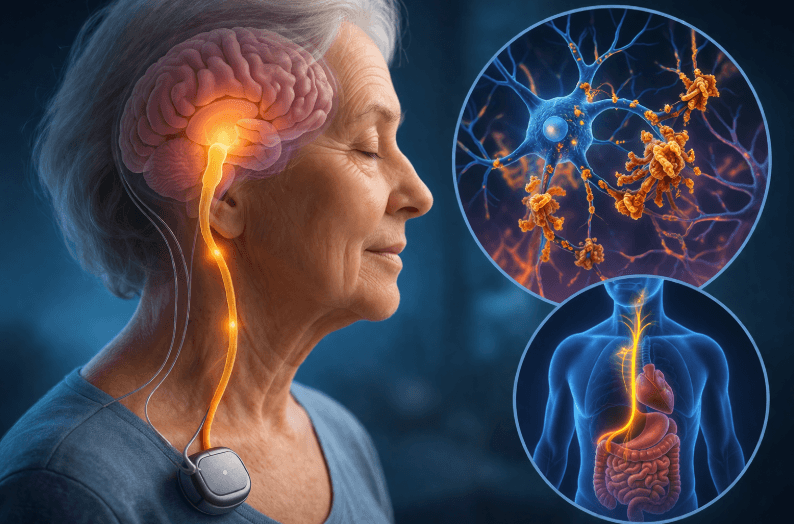
Alzheimer’s disease is often viewed in the United States as a condition that emerges late in life, typically after age 65. But growing evidence suggests that the biological changes tied to the disease begin decades earlier—sometimes as early as a person’s 20s or 30s. Researchers are now focusing on these early changes, hoping to slow or even prevent cognitive decline before symptoms appear.
One promising area of study involves a therapy already approved in the U.S. for other conditions: vagus nerve stimulation.
Early Brain Changes May Signal Future Alzheimer’s Risk
Long before memory loss becomes noticeable, subtle changes begin deep within the brain. One of the earliest involves the buildup of a protein called tau, which forms tangled structures inside nerve cells.
These tangles first appear in a small region of the brainstem known as the locus coeruleus. This area plays a central role in regulating sleep, attention, and alertness. Over time, tau can spread from this region to other parts of the brain.
Importantly, tau accumulation alone does not mean someone will develop Alzheimer’s. It occurs to some degree in most people as they age. However, because these changes start in the locus coeruleus, scientists increasingly view this region as an early warning system—a “canary in the coal mine”—for future cognitive decline.
Why the Locus Coeruleus Matters
Located at the base of the brain, the locus coeruleus produces most of the brain’s norepinephrine, a chemical that supports focus, learning, sleep cycles, and even immune responses.
Damage to this region, particularly from tau buildup, has been linked to memory decline. Studies show that degeneration in the locus coeruleus can occur in midlife and may precede the onset of Alzheimer’s symptoms by years.
This has led researchers to consider whether protecting this region could help preserve overall brain health and delay or prevent disease progression.
Vagus Nerve Stimulation Gains Attention
The vagus nerve acts as a communication highway between the brain and major organs such as the heart, lungs, and digestive system. It plays a key role in regulating essential bodily functions, including heart rate and digestion.
Vagus nerve stimulation (VNS) involves delivering mild electrical pulses to this nerve. In the U.S., the Food and Drug Administration (FDA) has already approved VNS for treating epilepsy, depression, and certain types of migraine, as well as aiding recovery after stroke.
Traditionally, VNS requires a small device implanted in the chest. However, newer noninvasive versions—similar to wearable health devices—can stimulate the nerve through the skin on the neck or ear.
How VNS May Affect the Brain
Researchers believe VNS may influence brain function by increasing levels of norepinephrine. This is significant because people with Alzheimer’s often have reduced norepinephrine activity.
Another leading theory is that VNS helps regulate the activity of neurons in the locus coeruleus. Rather than simply increasing or decreasing brain activity, it may fine-tune the timing and rhythm of neural signaling.
This balance is critical. Excessive activity in the locus coeruleus has been linked to anxiety and stress-related conditions such as post-traumatic stress disorder (PTSD), while insufficient activity may contribute to depression and memory problems.
By helping the brain maintain optimal levels of activity, VNS could act as a stabilizing mechanism—supporting both cognitive function and emotional regulation.
Early Evidence Suggests Memory Benefits
Although research is still in its early stages, several studies offer encouraging signs.
In one clinical trial involving adults ages 55 to 75 with mild cognitive impairment—a condition often considered a precursor to Alzheimer’s—participants who received VNS for one hour a day, five days a week, over six months showed measurable improvements in memory and overall cognitive performance.
Other studies have found that even a single session of VNS can enhance certain types of memory in both older adults and younger individuals. These findings suggest the therapy may have broader cognitive benefits beyond disease treatment.
Looking Ahead
Scientists caution that more research is needed to fully understand how VNS works and to determine its long-term effectiveness and safety for preventing Alzheimer’s disease. Large-scale clinical trials, similar to those required for new medical treatments in the U.S., will be essential.
Still, the idea of repurposing an existing, FDA-approved therapy offers a potentially faster path to real-world applications. If future studies confirm its benefits, VNS could become part of a broader strategy to address cognitive aging—alongside lifestyle interventions such as exercise, diet, and cardiovascular health management.
Conclusion
As researchers continue to uncover how Alzheimer’s disease develops decades before symptoms appear, attention is shifting toward early intervention. Protecting the locus coeruleus—a small but vital brain region—may be key to preserving memory over time. Vagus nerve stimulation, already used in American clinical practice for other conditions, is emerging as a promising tool in that effort, offering new hope in the fight against age-related cognitive decline.