
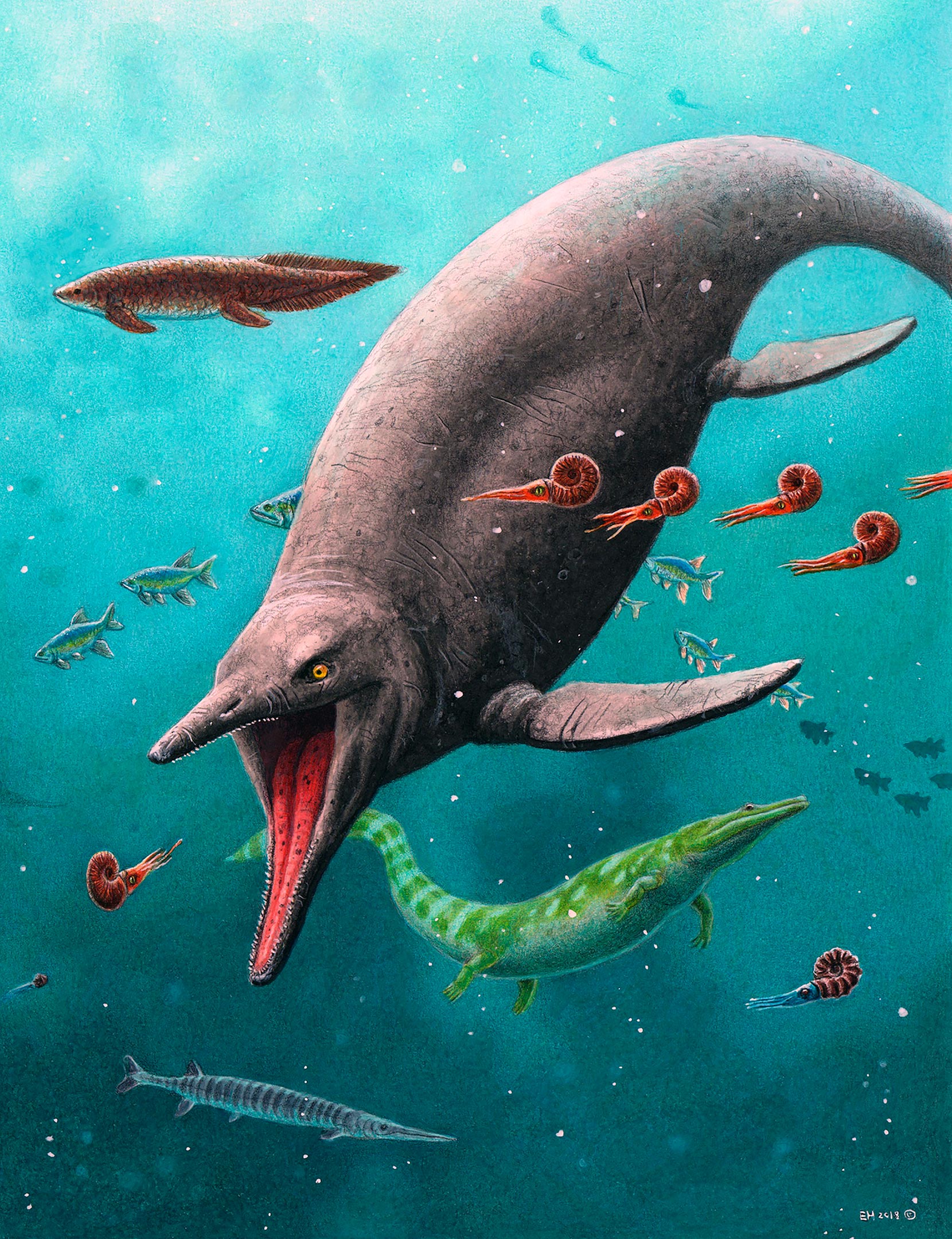

Reconstruction of the oldest ichthyosaur and the 250-million-year-old ecosystem found in Spitsbergen. Credit: Illustration by Esther Van Heulsen
For nearly 190 years, scientists have searched for the origins of ancient marine reptiles from the age of the dinosaurs. A team of Swedish and Norwegian paleontologists has discovered the remains of the oldest known ichthyosaur, or “fish lizard,” on the remote Arctic island of Spitsbergen.
Ichthyosaurs were an extinct group of marine reptiles whose fossils have been discovered all over the world. They were among the first land-living animals to adapt to life in the open sea, and evolved a “fish-like” body shape similar to modern whales. Ichthyosaurs were at the top of the food chain in the oceans while dinosaurs roamed the land, dominating marine habitats for more than 160 million years.

Sectional image and cross-section showing the internal bone structure of the vertebrae from an older ichthyosaur. Credit: Øyvind Hammer and Jørn Hurum
According to textbooks, reptiles first ventured into the open sea after the mass extinction at the end of the Permian period, which devastated marine ecosystems and paved the way for the dawn of the age of dinosaurs roughly 252 million years ago. As the story goes, land reptiles with walking legs invaded shallow coastal environments to take advantage of the niches for marine predators left vacant by this catastrophic event. Over time, these early amphibious reptiles became more efficient swimmers, eventually modifying their limbs into flippers, developing a fish-like body shape, and beginning to give birth to live young; Thus, they break their final bond with land by not having to come ashore to lay eggs.
New fossils unearthed in Spitsbergen are now revising this long-accepted theory.
Near the fishing cabins on the southern shore of the Ice Fjord in western Spitsbergen, Flower Valley cuts through the snow-capped mountains to reveal layers of rock that were once silt on the sea floor some 250 million years ago. A fast-flowing river fed by melting snow eroded the mudstone to reveal rounded limestone rocks called concrete. These were formed from calcareous deposits that settled around the decomposing remains of animals on the ancient sea floor, thus preserving them in stunning three-dimensional detail. Today, paleontologists are searching for these concrete blocks to examine fossil traces of dead sea creatures from long ago.

Fossil-bearing rocks on Spitsbergen that produce the remains of the first ichthyosaurs. Credit: Benjamin Kerr
During an expedition in 2014, a large number of concretes were collected from Flower Valley and shipped back to the Museum of Natural History in[{” attribute=””>University of Oslo for future study. Research conducted with The Museum of Evolution at Uppsala University has now identified bony fish and bizarre ‘crocodile-like’ amphibian bones, together with 11 articulated tail vertebrae from an ichthyosaur. Unexpectedly, these vertebrae occurred within rocks that were supposedly too old for ichthyosaurs. Also, rather than representing the textbook example of an amphibious ichthyosaur ancestor, the vertebrae are identical to those of geologically much younger larger-bodied ichthyosaurs, and even preserve internal bone microstructure showing adaptive hallmarks of fast growth, elevated metabolism and a fully oceanic lifestyle.
Geochemical testing of the surrounding rock confirmed the age of the fossils at approximately two million years after the end-Permian mass extinction. Given the estimated timescale of oceanic reptile evolution, this pushes back the origin and early diversification of ichthyosaurs to before the beginning of the Age of Dinosaurs; thereby forcing a revision of the textbook interpretation and revealing that ichthyosaurs probably first radiated into marine environments prior to the extinction event.
Excitingly, the discovery of the oldest ichthyosaur rewrites the popular vision of Age of Dinosaurs as the emergence timeframe of major reptile lineages. It now seems that at least some groups predated this landmark interval, with fossils of their most ancient ancestors still awaiting discovery in even older rocks on Spitsbergen and elsewhere in the world.
The paper is published in the prestigious international life sciences journal Current Biology.
Reference: “Earliest Triassic ichthyosaur fossils push back oceanic reptile origins” by Benjamin P. Kear, Victoria S. Engelschiøn, Øyvind Hammer, Aubrey J. Roberts and Jørn H. Hurum, 13 March 2023, Current Biology.
DOI: 10.1016/j.cub.2022.12.053