
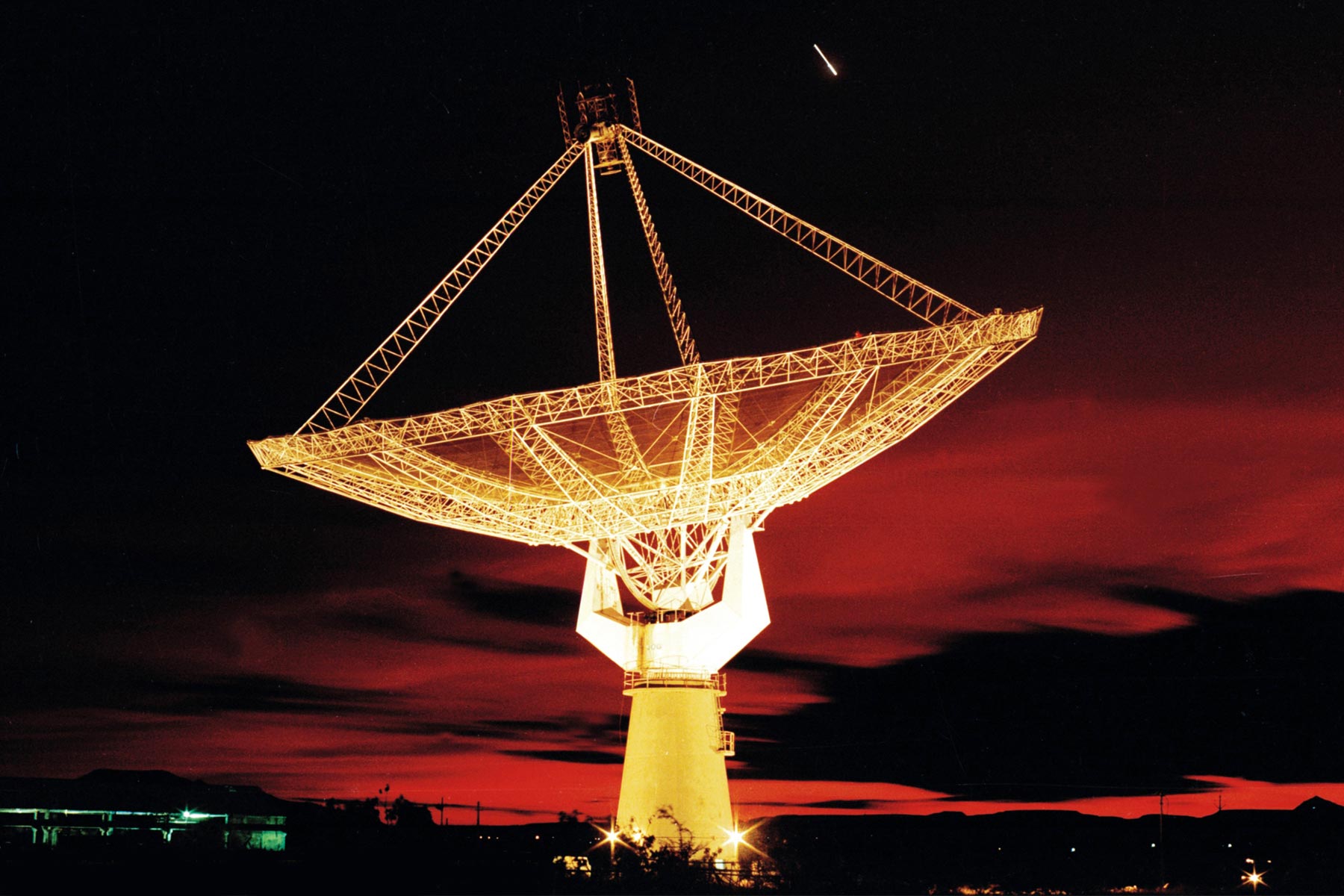
A dish of the Giant Metrewave Radio Telescope (GMRT) near Pune, Maharashtra, India. Credit: National Center for Radio Astrophysics
Exploring galaxies at far greater distances than Earth may now be within reach.
How do stars form in distant galaxies? Astronomers have long been trying to answer this question by detecting radio signals emitted by nearby galaxies. However, these signals become weaker the farther the galaxy is from Earth, making it difficult for current radio telescopes to pick up on them.
Now researchers from Montreal and India have captured a radio signal from the most distant galaxy yet at a specific wavelength known as the 21-cm line, allowing astronomers to delve deeper into the mysteries of the early universe. With the help of the Giant Metrewave radio telescope in India, this is the first time that this type of radio signal has been detected at such a great distance.
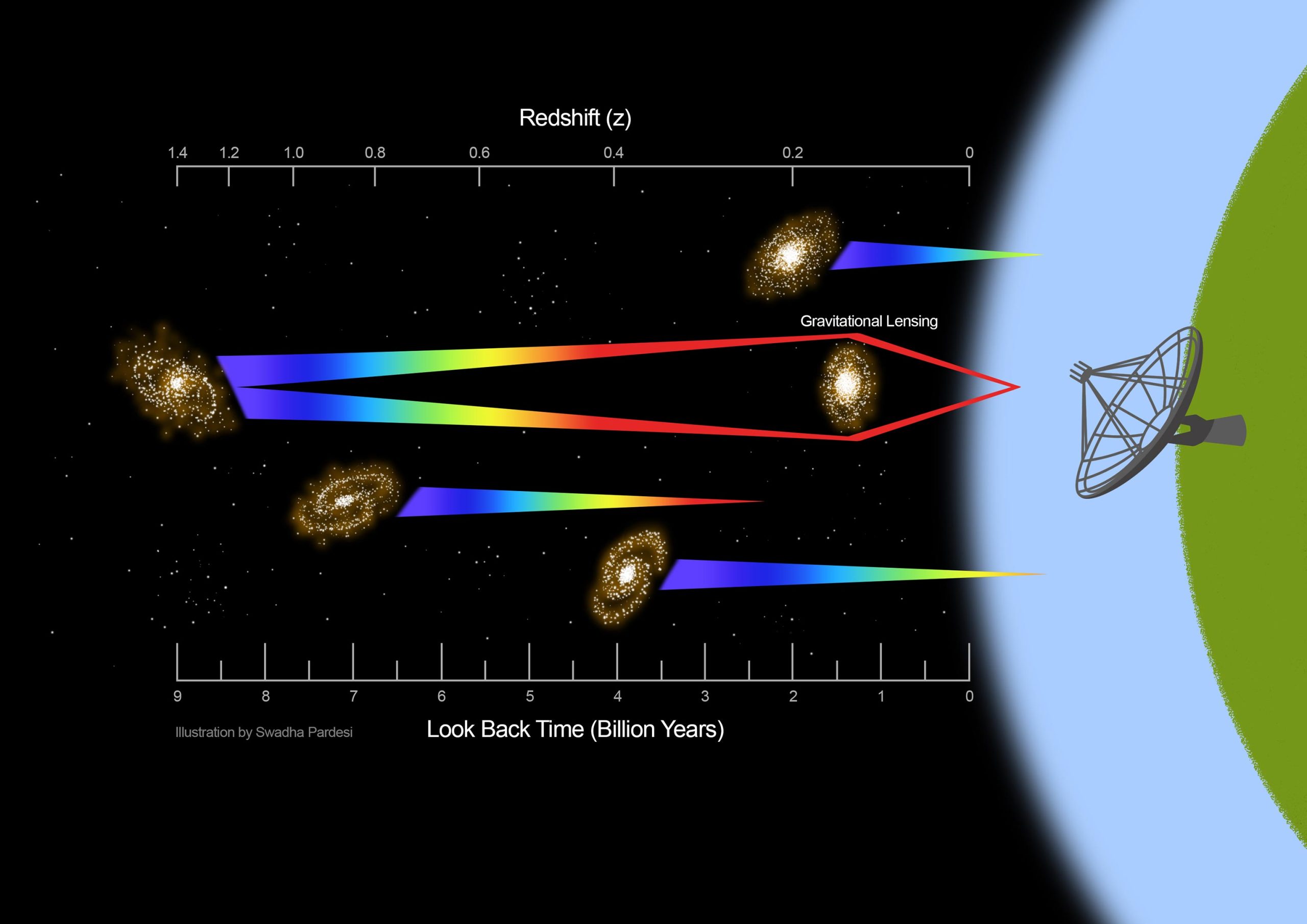
Illustration showing the detection of a signal from a distant galaxy. Credit: Sawada Pardesi
“A galaxy emits different types of radio signals. Until now, it was only possible to pick up this particular signal from a nearby galaxy, which limits our knowledge of those galaxies closest to Earth,” says Arnab Chakraborty, a postdoctoral researcher at McGill University under Supervising by Professor Matt Dobbs.
But with the help of a naturally occurring phenomenon called gravitational lensing, we can pick up a faint signal from a record distance. This will help us understand the formation of galaxies at much greater distances from Earth.”
A look back in time to the early universe
For the first time, researchers have been able to detect the signal from a distant star-forming galaxy known as SDSSJ0826+5630 and measure the composition of its gas. The researchers note that the atomic mass of the gas content in this particular galaxy is almost twice the mass of the stars visible to us.
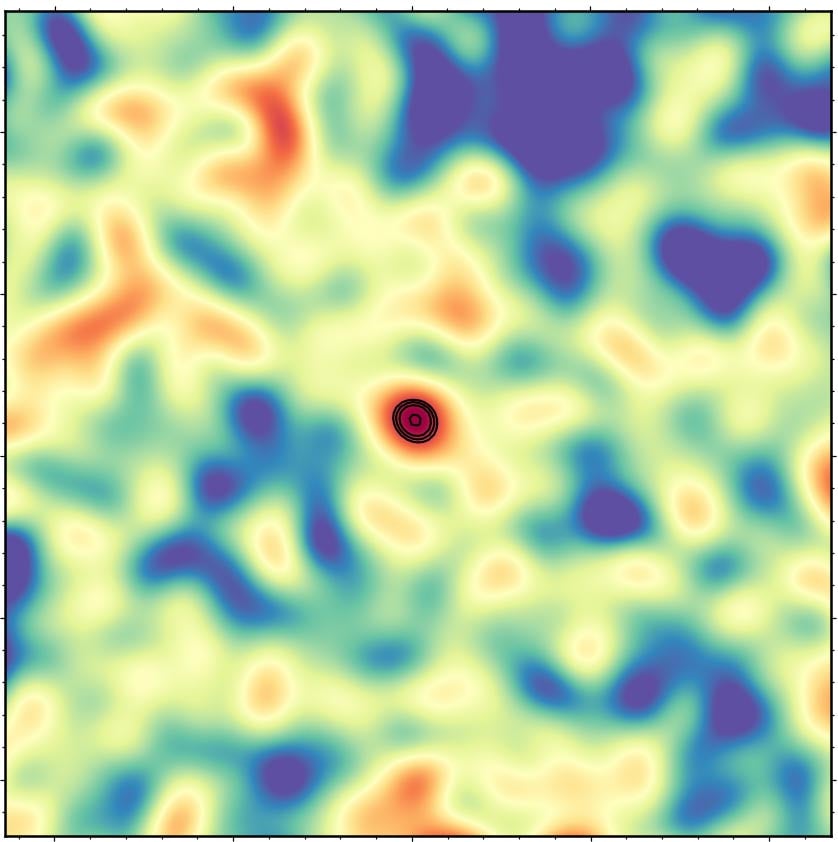
Image of a radio signal from the galaxy. Credit: Chakraborty and Roy/NCRA-TIFR/GMRT
The signal the team detected was emitted from this galaxy when the universe was only 4.9 billion years old, enabling the researchers to glimpse into the mysteries of the early universe. “It’s the equivalent of looking back in time 8.8 billion years,” says Chakraborty, who studies cosmology in the Department of Physics at McGill University.
Capture the signal from a distant galaxy
“Gravitational lensing amplifies the signal coming from a distant object to help us look out into the early universe. In this specific case, the signal is bent by the presence of another massive object, another galaxy, between the target and the observer. This effectively amplifies the signal by a factor of 30, allowing telescope to capture them,” says co-author Nirupam Roy, associate professor in the Department of Physics at the Indian Institute of Science.
According to the researchers, these results show the feasibility of observing distant galaxies in similar situations using gravitational lensing. It also opens exciting new opportunities for investigating the cosmic evolution of stars and galaxies using today’s low-frequency radio telescopes.
Reference: “21-cm HI emission detected from an intensely lensed galaxy at z ∼1.3” by Arnab Chakraborty and Nirupam Roy, December 23, 2022, Available here. Monthly Notices of the Royal Astronomical Society.
DOI: 10.1093/mnras/stac3696
The Giant Metrewave Radio Telescope is built and operated by NCRA-TIFR. The research was funded by McGill University and the Indian Institute of Science.