
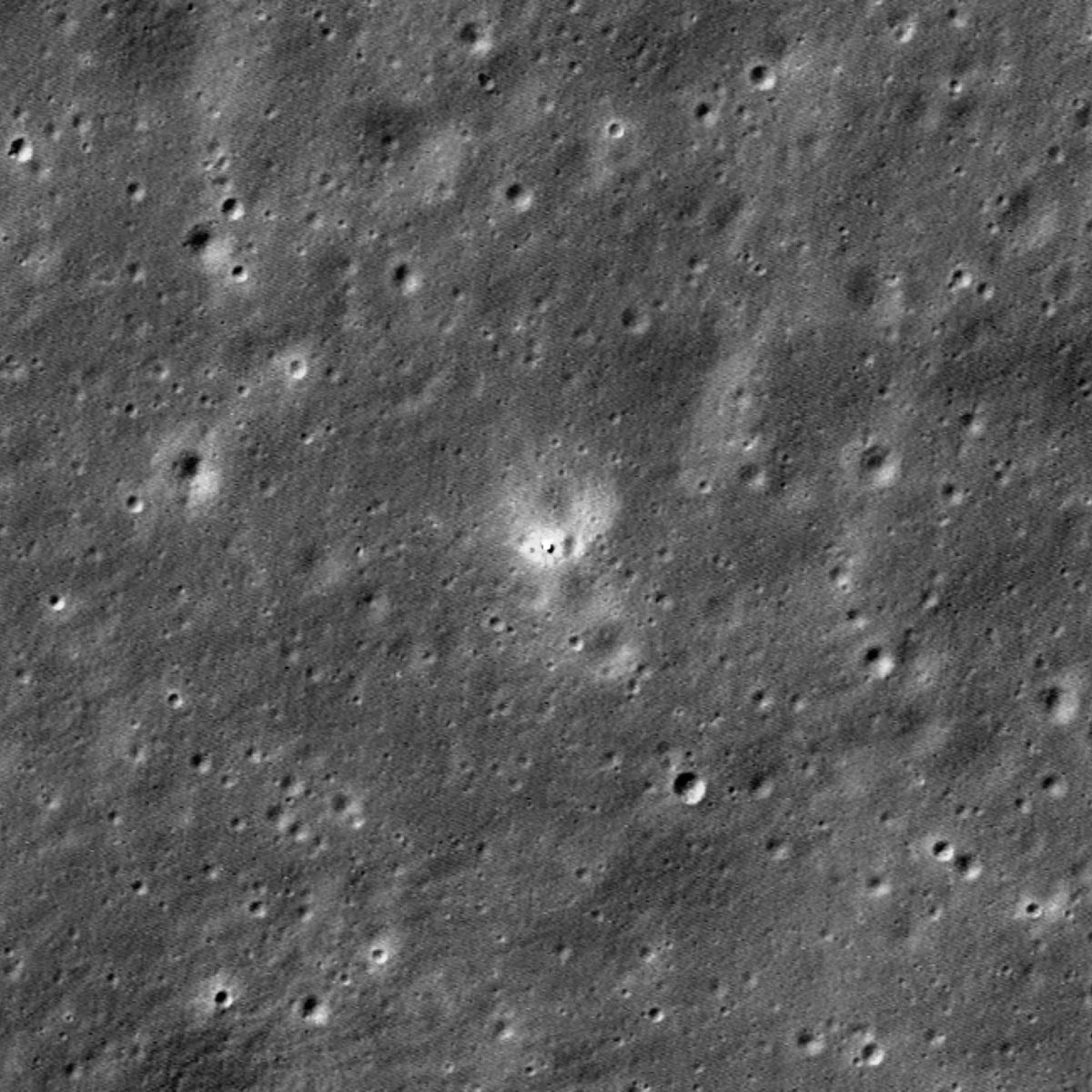
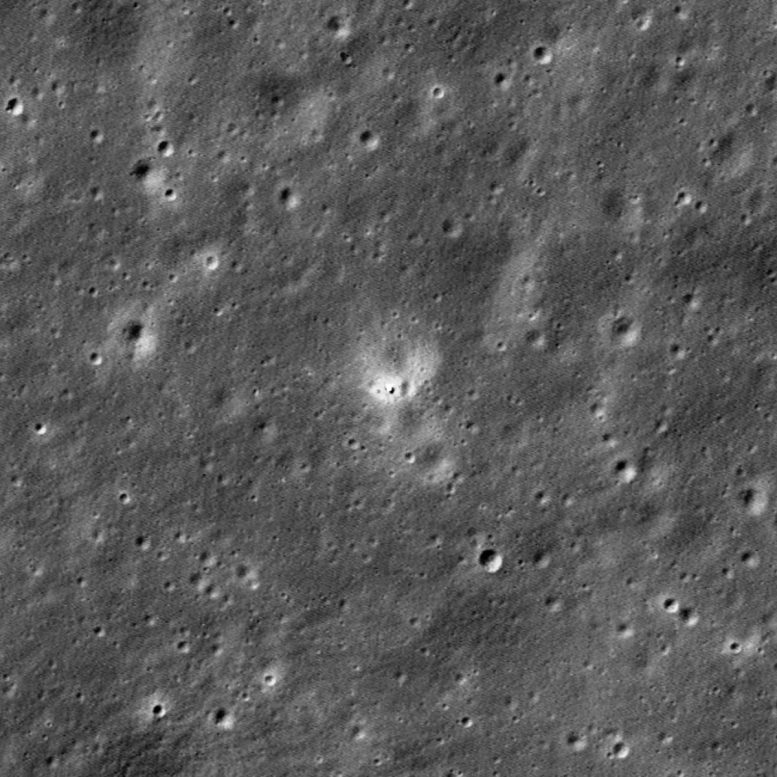
This image from NASA’s Lunar Reconnaissance Camera shows China’s Chang’e 6 rover in the Apollo Basin on the far side of the Moon on June 7, 2024. The lander is seen as a small group of bright pixels in the center of the image. The image is 552 meters wide; North is up. Image source: NASA/GSFC/Arizona State University
NASALunar Reconnaissance Orbiter has captured an image of China’s Chang’e 6 lunar rover, revealing its location on a crater within the geologically rich Apollo Basin, which is characterized by ancient basalt flows.
NASA’s Lunar Reconnaissance Orbiter (LRO) imaged China’s Chang’e 6 spacecraft on the far side of the Moon on June 7. Chang’e 6 landed on June 1, and when LRO passed over the landing site about a week later, it obtained an image showing the lander at the edge of an eroded crater 55 yards (about 50 meters) in diameter.
The LRO camera team calculated the coordinates of the landing site at 42 degrees south latitude, 206 degrees east longitude, at an altitude of about 3.27 miles (minus 5,256 meters).
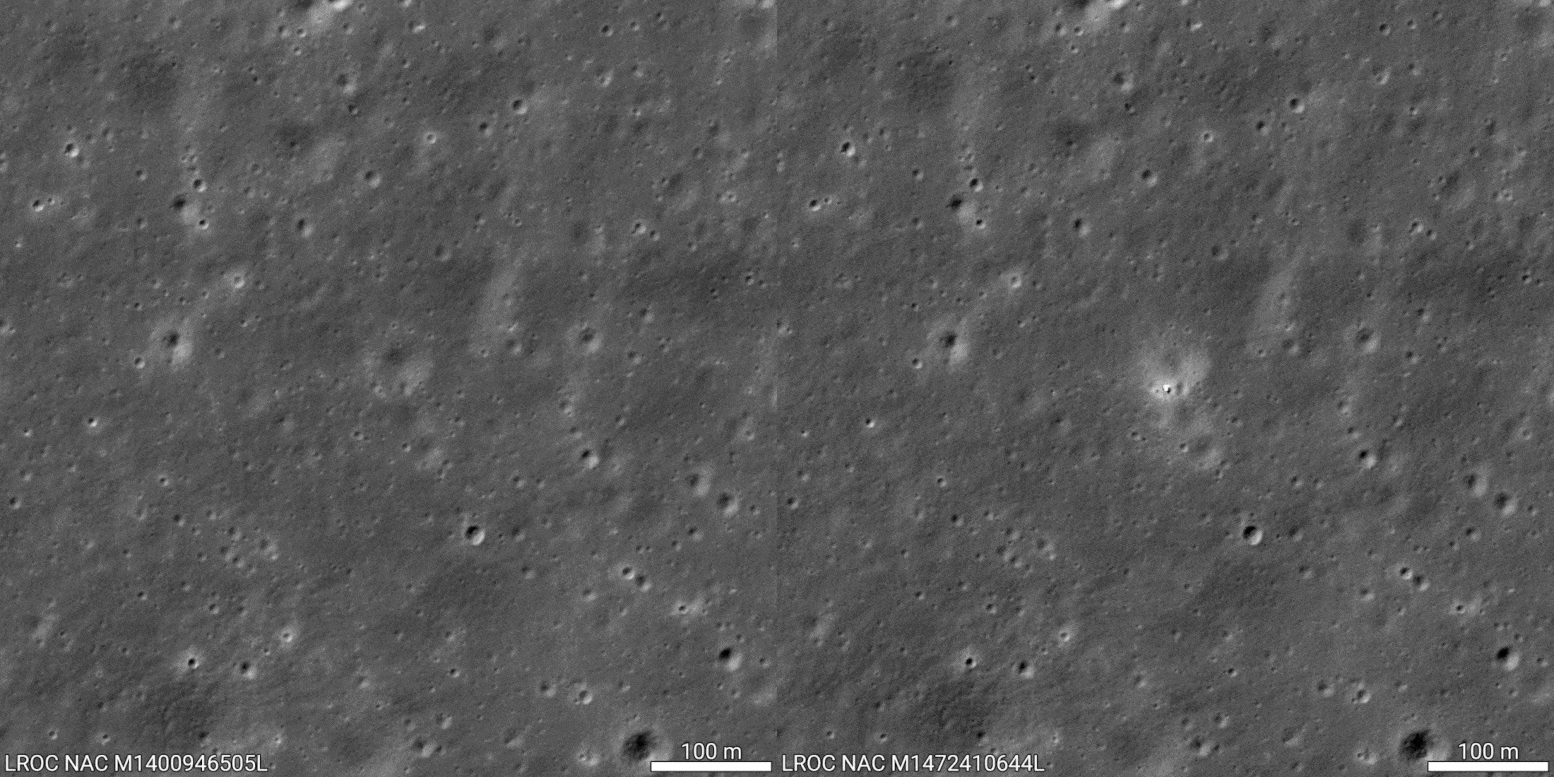
This animation of before-and-after LRO images shows the appearance of the Chang’e 6 lander. The increased brightness of the terrain around the lander is due to turbulence of the vehicle’s engines and resembles the blast zone seen around other landers on the Moon’s surface. The before image is from March 3, 2022, and the after image is from June 7, 2024. Source: NASA/GSFC/Arizona State University.
The Chang’e 6 landing site is located toward the southern edge of the Apollo Basin (about 306 miles or 492 km in diameter, centered at 36.1 degrees south latitude, 208.3 degrees east longitude). Basalt lava erupted south of the Chave S crater about 3.1 billion years ago and flowed downhill to the west until it encountered a local topographic rise, likely associated with a fault. Numerous wrinkle protrusions in this area have distorted and raised the surface of the mare. The landing site is located approximately halfway between two of these prominent hills. This basalt flow also overlaps a slightly older flow (about 3.3 billion years ago), which can be seen to the west, but the younger flow is distinct because it contains higher amounts of iron oxide and titanium dioxide.
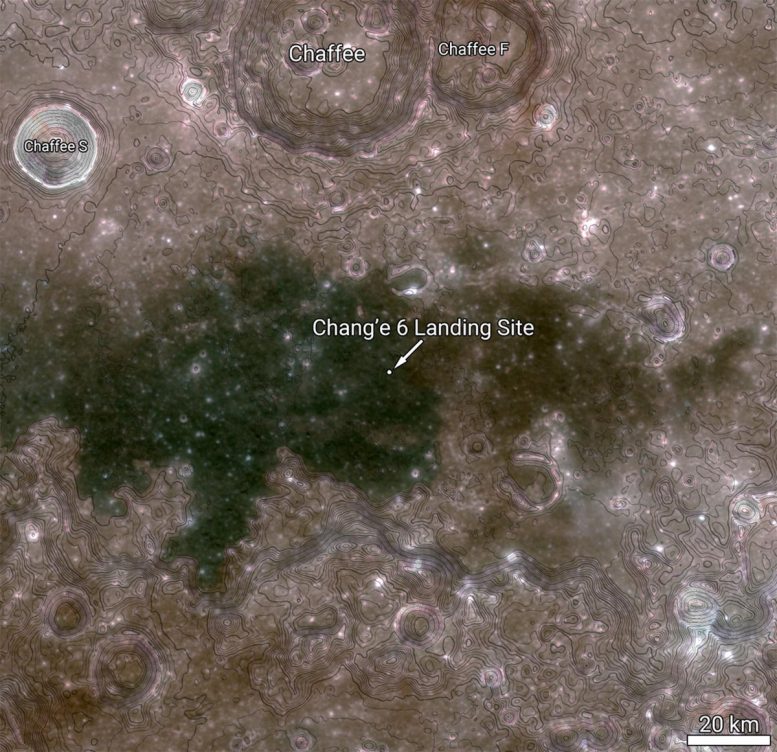
Regional context map of Chang’e 6 landing site. Color variations have been enhanced for clarity. The dark area is a basalt mare deposit. The bluer areas in the mare are higher fluxes of titanium. Contour lines marking 100 m (about 328 ft) elevation intervals are overlaid to provide a sense of terrain. The image is about 118 miles (190 km) wide. Image source: NASA/GSFC/Arizona State University
NASA’s Lunar Reconnaissance Orbiter (LRO) is a coaxial spacecraft designed for detailed exploration of the lunar surface. Launched on June 18, 2009, the mission primarily aims to collect high-resolution images and data to facilitate the selection of future landing sites, assess the Moon’s mineral resources, and analyze the lunar radiation environment. Equipped with an array of powerful instruments, including high-resolution cameras and a laser altimeter, LRO maps lunar terrain in exceptional detail, helping scientists understand the lunar geology and identify resource-rich regions such as water ice.
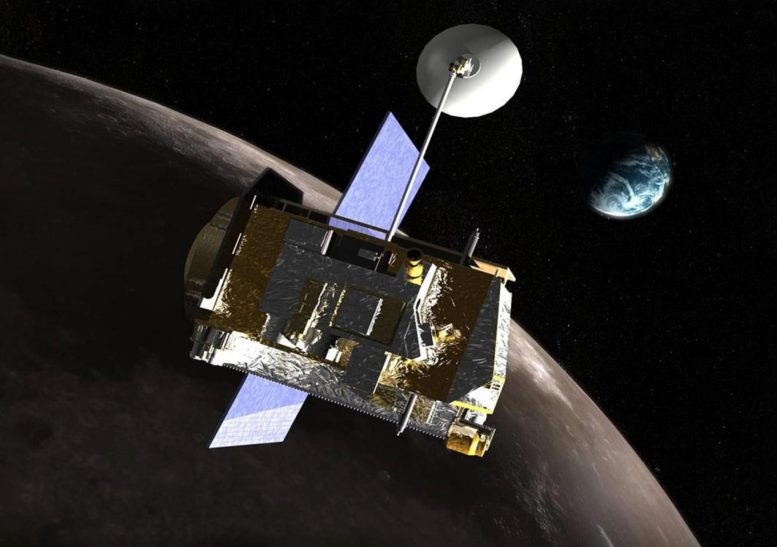
Artistic rendering of NASA’s Lunar Reconnaissance Orbiter. Source: NASA Goddard Space Flight Center
LRO has greatly advanced our knowledge of the Moon, contributing to discoveries such as confirming the presence of water ice in permanently shadowed craters and mapping the Moon’s surface temperatures. Instruments such as the Lunar Orbiter Laser Altimeter (LOLA) and the Diviner Lunar Radiometer Experiment provide important data on the Moon’s topography and thermal behavior, which is critical for planning future human and robotic missions. By continuing to transmit valuable data back to Earth, LRO supports ongoing research that advances our strategies for returning to the Moon and beyond, making it a cornerstone of lunar exploration technology.
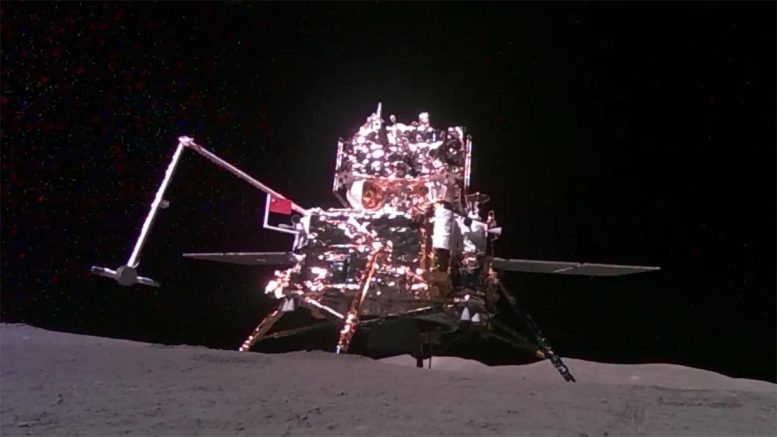
Chang Ah 6 down and up. Credit: China National Space Administration
Chang’e 6, part of China’s lunar exploration program and named after the Chinese moon goddess, is a robotic lunar mission operated by the China National Space Administration. The mission launched from Hainan Island on May 3, 2024, and included a lander and a rover equipped with a mobile camera that touched down on the far side of the Moon on June 1, 2024. This mission, China’s second to involve returning samples, involved collecting samples from the Moon using a robotic scoop and drill. These samples were transferred to the ascent module, which then docked with an orbiter in lunar orbit on June 6, 2024, to transport the samples for return to Earth. In addition, the lander and rover conducted various scientific experiments on the Moon.