
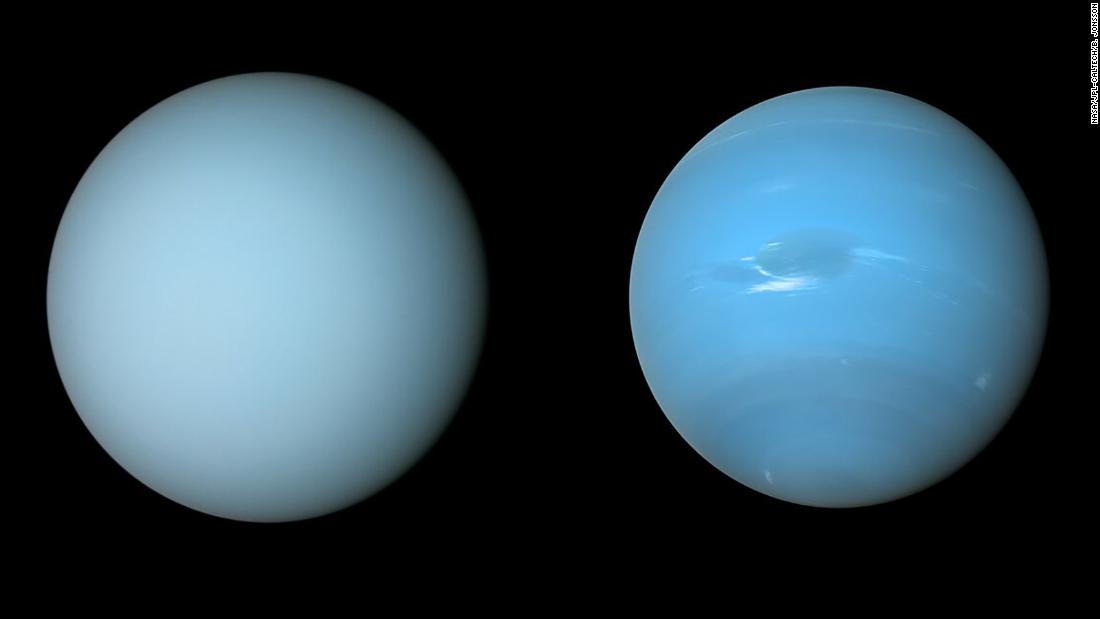
New space and ground-based telescope observations have revealed what’s behind this difference in tone.
The planets farthest from the sun in our solar system, Neptune and Uranus, have the same sizes, masses, and atmospheric conditions. Looking at the two planets side by side, which was made possible after NASA’s Voyager 2 spacecraft flew by in the 1980s, Neptune has a bright blue appearance. Uranus is a pale shade of azure.
The astronomers used the Gemini North Telescope and NASA’s Infrared Telescope Facility, both in Hawaii, and the Hubble Space Telescope to create a model that could match observations of Neptune and Uranus.
Scientists have determined that excess haze has accumulated in the atmosphere of Uranus, giving it a lighter appearance. This haze is thicker on Uranus than a similar layer of atmosphere on Neptune, so it whitens the appearance of Uranus from our perspective.
Previous attempts to understand this difference have focused on the upper atmospheres of planets at specific wavelengths of light.
“This is the first model to synchronously fit observations of reflected sunlight from ultraviolet to near infrared,” senior study author Patrick Irwin, professor of planetary physics at the University of Oxford, said in a statement. He is also the first to explain the difference in visible color between Uranus and Neptune.
The model also probed deeper atmosphere layers that include fog particles, as well as clouds of methane and hydrogen sulfide.
New observations from the Gemini North Telescope, located near the summit of Mauna Kea in Hawaii, have been paired with other archival telescope data. The team analyzed three layers of aerosols at different altitudes on Uranus and Neptune. The middle layer of fog particles is what affects the color the most.
On both planets, the middle layer is where methane ice turns into methane showers. Neptune has a turbulent atmosphere that is more active than the slow, sluggish Uranus atmosphere, so methane particles and showers of snow prevent fog from accumulating on the planet Neptune.
Scientists believe this model could also help explain why dark spots appear on Neptune, but are less common on Uranus. This is likely due to the fact that the deepest layer of the atmosphere is getting darker, which will be more noticeable on the planet Neptune.
“We hoped that developing this model would help us understand the clouds and haze in the atmosphere of the ice giant,” study co-author Mike Wong, an astronomer at the University of California, Berkeley, said in a statement. “Explaining the difference in color between Uranus and Neptune was an unexpected bonus!”
We can learn more about these mysterious worlds, which Voyager 2 visited only during fast flights.