
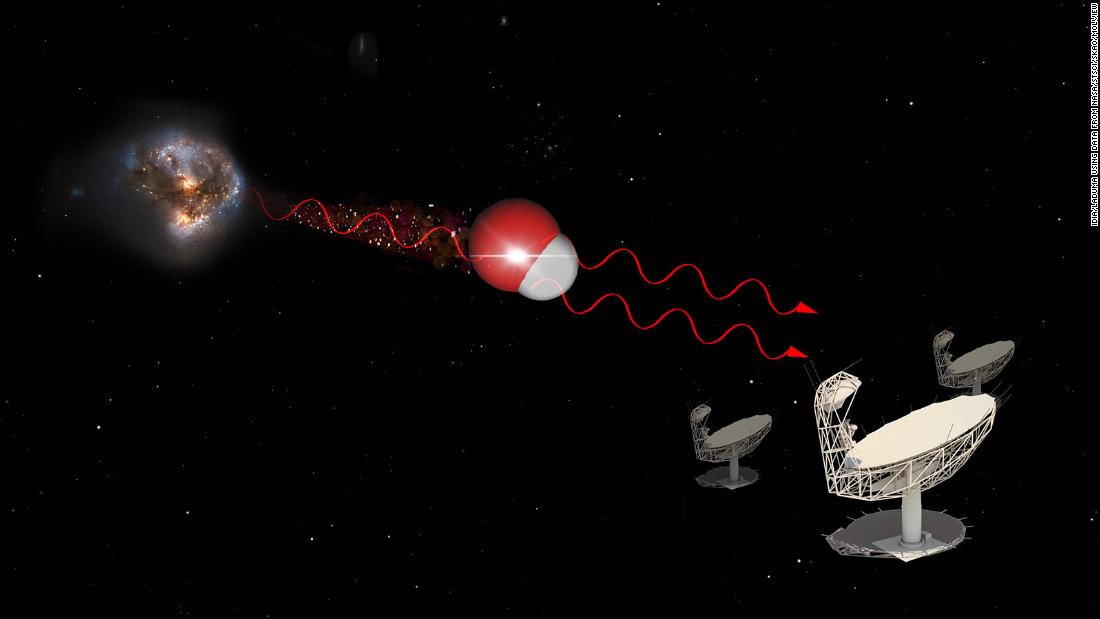
This massive laser is the most distant ever observed, 5 billion light-years from Earth.
The light emitted by the space laser traveled 36 billion billion miles (58 thousand billion kilometers) to reach our planet.
An international team of astronomers, led by Marcin Glowacki, observed this light using the MeerKAT telescope of the South African Radio Astronomy Observatory. (MeerKAT is an acronym for Karoo Array Telescope, prefixed with the Afrikaans word for “more.”)
Glowacki is a research associate at the Curtin University Center for International Radio Astronomy Research in Australia.
Megamasers are created when two galaxies collide with each other. Glowicki said it was the first hydroxyl megamaser that Meerkat had noticed.
Hydroxl, a chemical group consisting of one hydrogen atom and one oxygen atom, can be found within galactic mergers.
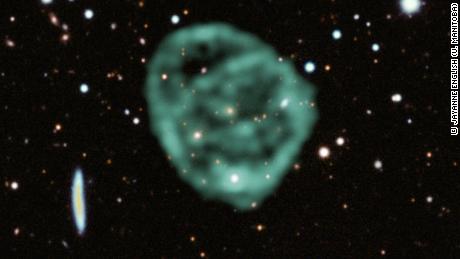
“When galaxies collide, the gas they contain becomes very dense and can release focused beams of light,” Glowicki said in a statement.
The research team named the laser Nkalakatha, which means “big leader” in isiZulu, the Bantu language of Zulus in South Africa.
Astronomers discovered the megamasers on the first night of a survey that spanned more than 3,000 hours of observing time using MeerKAT.
“It’s impressive that in just one night of observations, we actually found a record-breaking megamaser,” Glowaki said. “It shows how good the telescope is.”
The research team continues to use MeerKAT to closely monitor narrow areas of the sky and search for the same items spied on in Megamasers. Doing so could provide more insights into how the universe evolved.
“We have follow-up observations of megamasers planned and hope to make more discoveries,” Glowaki said.
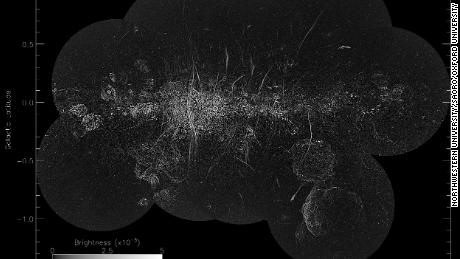
The MeerKAT telescope, located in the Karoo region of South Africa, has an array of 64 radio dishes and has been in operation since July 2018. The powerful telescope is sensitive to dim radio light.
MeerKAT is a precursor to the Transcontinental Square Kilometer Array, or SKA, a telescope under construction in both South Africa and Australia.
The array will include thousands of dishes and up to one million low-frequency antennas in an effort to build the world’s largest radio telescope.
Despite the fact that these dishes and antennas will be in different parts of the world, together they will create one telescope with an area of more than one square kilometer (0.39 square miles). As a result, astronomers can scan the entire sky much more quickly than other telescopes.