
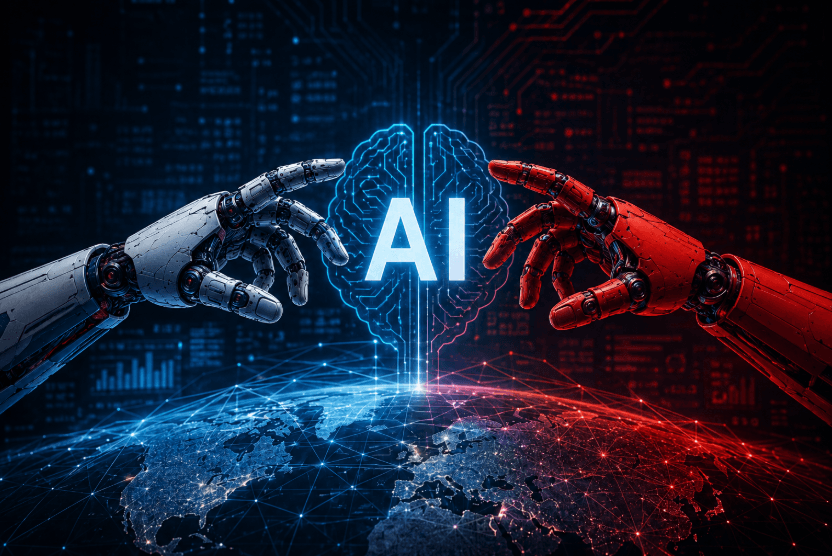
The battle for dominance in artificial intelligence is rapidly becoming one of the defining geopolitical and economic rivalries of the 21st century, with the United States and China emerging as the two clear front-runners. As both nations invest billions into AI development, industry leaders and policymakers increasingly view the technology as critical not only for economic growth, but also for national security and global influence.
The rivalry is expected to feature prominently in discussions at next week’s summit between President Donald Trump and Chinese President Xi Jinping, where technology, trade, and semiconductor access are likely to be major points of negotiation.
Nvidia’s Jensen Huang Warns of High-Stakes AI Competition
At an awards ceremony in New York City late last month, many of the technology sector’s most influential executives and engineers gathered to celebrate advancements in innovation and computing. The evening’s main attraction was Jensen Huang, founder and chief executive of Nvidia, whose company has become one of the world’s most valuable businesses thanks to soaring demand for AI chips.
Speaking to attendees at the Institute of Electrical and Electronics Engineers event, Huang described artificial intelligence as a technological shift unlike previous industrial revolutions.
“In some ways, engineers have been at the centre of every industrial revolution,” Huang said, referencing eras shaped by steam power, electricity, and information technology.
“But this one, artificial intelligence, will be different,” he added. “This revolution will be deeply profound, and we have to engage it with enthusiasm and optimism on the one hand, but surely with responsibility at its core.”
While the event focused largely on innovation and opportunity, the broader geopolitical implications of AI development remained an unmistakable undercurrent throughout the gathering.
AI Seen as Strategic Battleground Between Washington and Beijing
Behind the scenes, many technology executives increasingly believe the AI revolution will unfold as a direct strategic contest between the United States and China. The stakes extend well beyond commercial success, touching everything from military applications and cybersecurity to global economic leadership.
The U.S. currently maintains an advantage in several key areas, including advanced semiconductor manufacturing, research universities, venture capital funding, and leading AI companies such as OpenAI, Google, Microsoft, and Nvidia. Washington has also imposed export restrictions aimed at limiting China’s access to the most advanced AI chips and chipmaking equipment.
China, however, continues to move aggressively to close the gap. Beijing has made AI development a national priority, investing heavily in domestic semiconductor production, cloud computing infrastructure, and AI research. Chinese technology giants including Alibaba, Tencent, Baidu, and Huawei are all expanding their AI capabilities while the government pushes for greater technological self-sufficiency.
During last year’s Future of AI summit in London, Huang made headlines when he told the Financial Times: “China is going to win the AI race.”
The remark underscored growing concerns within parts of the U.S. technology sector that China’s scale, engineering talent, and state-backed investment strategy could eventually reshape the balance of power in the industry.
Experts Divided Over China’s Long-Term AI Prospects
Not everyone in the technology world agrees with Huang’s assessment. Many analysts argue that while China is likely to remain highly competitive, the United States still holds a meaningful lead in cutting-edge AI development and innovation.
American companies currently dominate the market for high-performance AI processors, large language models, and advanced cloud infrastructure. Silicon Valley also continues to attract global engineering talent and investment at a scale unmatched by most competitors.
At the same time, experts note that China possesses significant advantages of its own, including access to vast amounts of consumer data, strong government coordination, and a rapidly growing domestic technology market.
Some analysts believe the competition could ultimately resemble the broader U.S.-China economic relationship: deeply interconnected, highly competitive, and difficult for either side to decisively win.
Trump-Xi Summit Could Shape Future of AI Policy
Technology policy is expected to play a central role at the upcoming Trump-Xi summit, particularly as tensions continue over trade restrictions and semiconductor exports. AI-related negotiations could influence global supply chains, investment flows, and international technology standards for years to come.
For U.S. policymakers, maintaining leadership in AI has become increasingly tied to national competitiveness and security. Lawmakers in Washington have pushed for expanded domestic chip manufacturing, tighter export controls, and greater investment in AI research.
China, meanwhile, continues to emphasize technological independence as a strategic objective amid ongoing restrictions from the United States and its allies.
AI Competition Expected to Define the Next Decade
As artificial intelligence reshapes industries ranging from healthcare and finance to defense and transportation, the competition between the United States and China is likely to intensify. Both countries see AI as essential to future economic growth and geopolitical influence, ensuring the rivalry will remain at the center of global technology discussions for years to come.
Whether one nation ultimately pulls ahead or both remain closely matched, the outcome of the AI race could have lasting consequences for the global economy, international politics, and the future direction of technological innovation.