
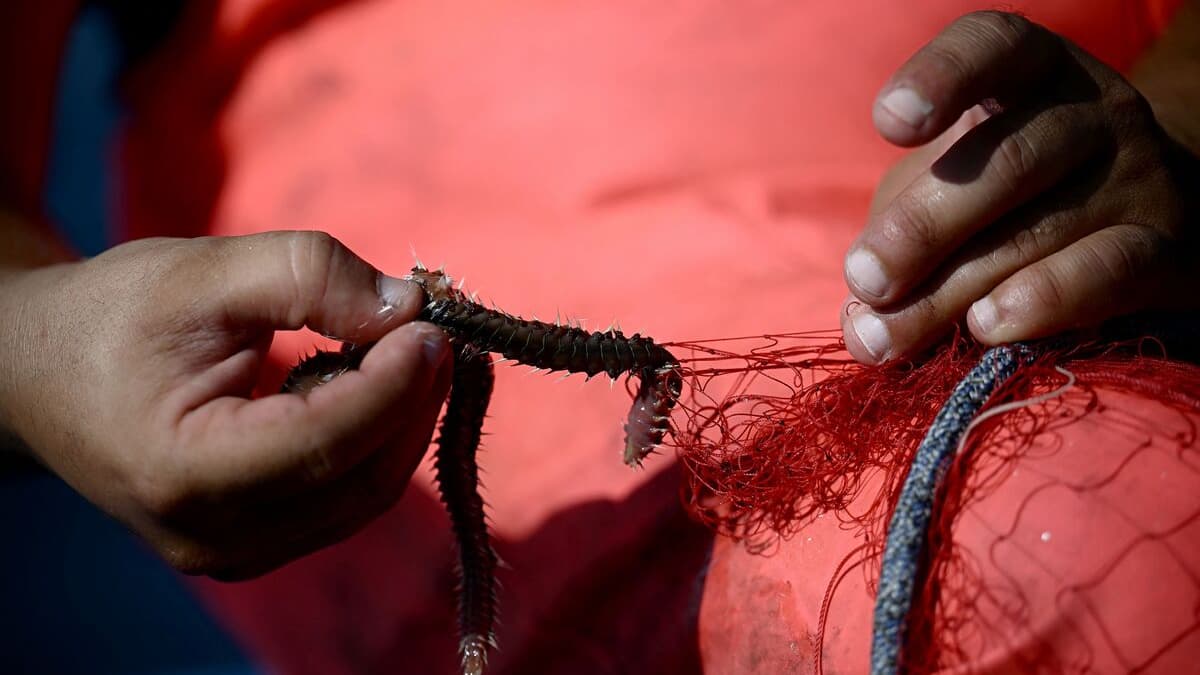
The fish Alfonso Barron hauls into his nets off the coast of Sicily are half-devoured by fireworms, worrying the ferocious predators that thrive in the Mediterranean’s increasingly warm waters.
These centipede-like creatures love everything from coral to fish caught in fishing nets, while rising water temperatures fueled by climate change encourage their proliferation. They usually measure between 15 and 30 cm, but can reach up to 50 cm.
Alfonso Barron pulls a long, spinning red worm from a headless mackerel in his boat. Its white hairs with venom come off at the slightest contact and penetrate the skin, giving a sharp burning sensation. The 34-year-old says he was stabbed multiple times, including once in the eye.
Once the fish is caught in the net, the maggots feed on the fish. Also known as barbed worms, they “eat the head and the whole body and throw it out,” explains the fisherman, dragging a decomposed seaweed from the beach at the popular tourist destination of Marzamemi village on the southeastern tip. Sicily.
Fireworms are not new to the Mediterranean, but they were once very few and only found in Sicily in the summer.
“With global warming, the water warms up and becomes an ideal habitat for these worms, which are present in large numbers every year and throughout the year,” notes Alfonso Barron, who has been fishing since his childhood.
Half-eaten fish cannot be sold. Fishermen therefore reduce the time they sink their nets, resulting in fewer catches and attacks by brown, green or red worms cannot be completely prevented.
“They used to eat about 30% of the catch… now that number has increased to 70%,” he laments.
Hunter and scavenger
The worms also migrate to new areas: Zoologist Francesco Tralongo, who heads a project at the University of Sicily in Catania studying this phenomenon, has recorded cases in Calabria, the tip of the Italian boot.
The fireworm is an opportunistic species that acts as both a predator and a scavenger, and “they have impressive numbers…in very shallow water,” he notes in an interview with AFP.
At Marzamemi Beach, slightly anxious vacationers don masks or plastic shoes before swimming.
“I don’t let it spoil my vacation, but I always swim with my mask on,” says Fabiana Davanzo, a 56-year-old tourist from Milan (North).
As 51-year-old Salvador Lázaro carefully dips his feet in the water, he explains that he was stung by an unidentified creature the day before, but bravely uses the water again under the sun.
Fears for swimmers and loss of income for fishermen are not the only issues.
“Global warming is causing various changes in the Mediterranean Sea, which will probably worsen in the coming years,” warns Federico Betti, an invasive species expert at the University of Genoa (Northeast).
He recalls that the average temperature of the Mediterranean Sea has increased by about 1.2 degrees in the last 40 years.
“Deep Changes”
The warming of the oceans reduces the seasonal variation of existing species and results in diverse environments that cannot harbor rich ecosystems.
Heat can also cause mass mortality events within a species, Federico Petti emphasizes.
On the other hand, other species benefit: we see an increase in non-native tropical species in the Mediterranean, which “cause profound changes in marine ecosystems,” worries Francesco Tralongo.
These include the blue crab that destroys shellfish farms in the Po Delta in northern Italy.
These crabs have no natural predators, but Italians try to make them rich by eating them.
Fireworm spaghetti is unfortunately not an option.
Although more research is needed on potential solutions, Mr. Dralongo had already made a disturbing discovery: “The fireworm cannot be killed by cutting it in half, because it has excellent regenerative abilities.”
“If you cut it in half, the part with the head regenerates a back part, but the back part regenerates a head in about 22 days.”