
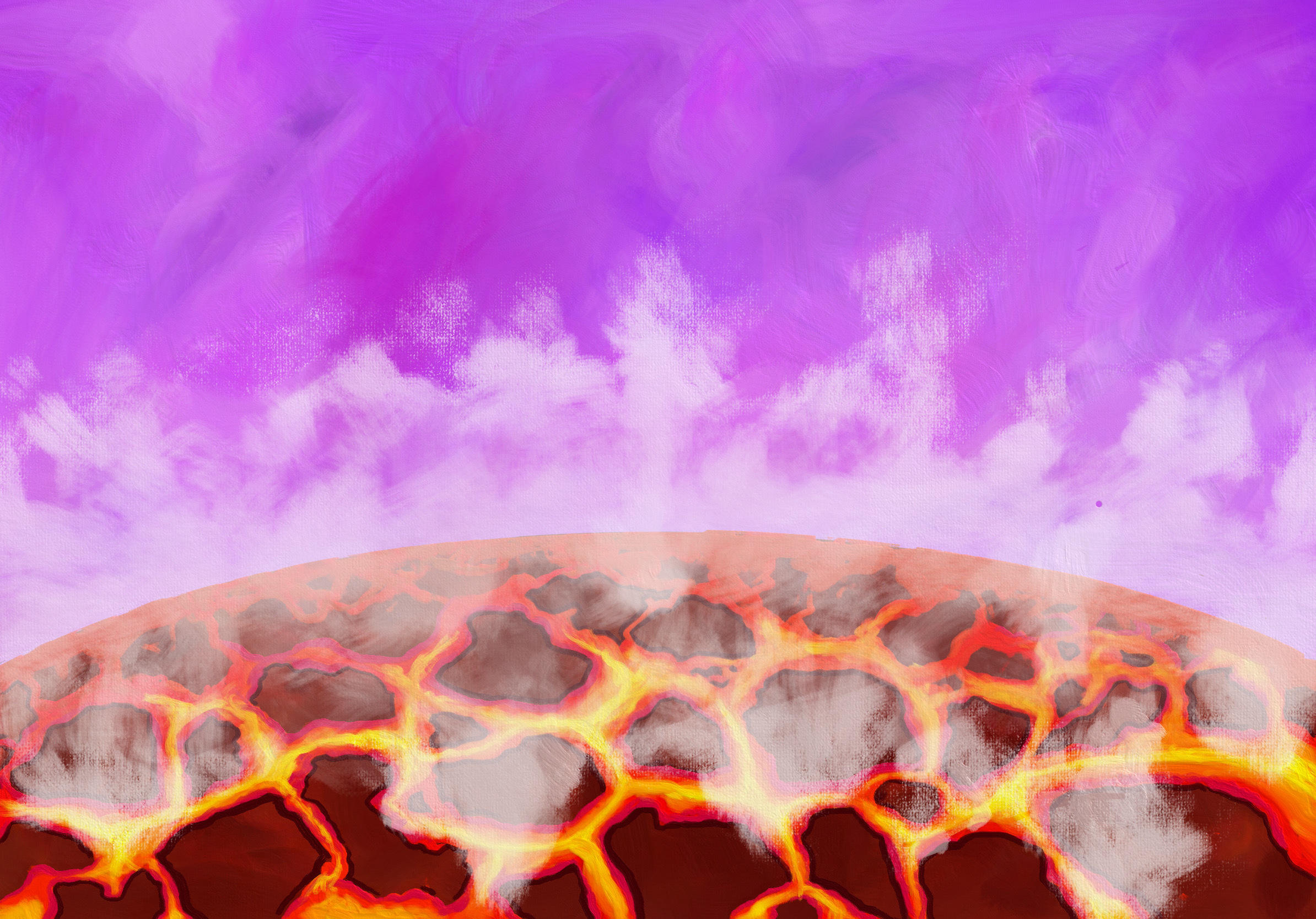
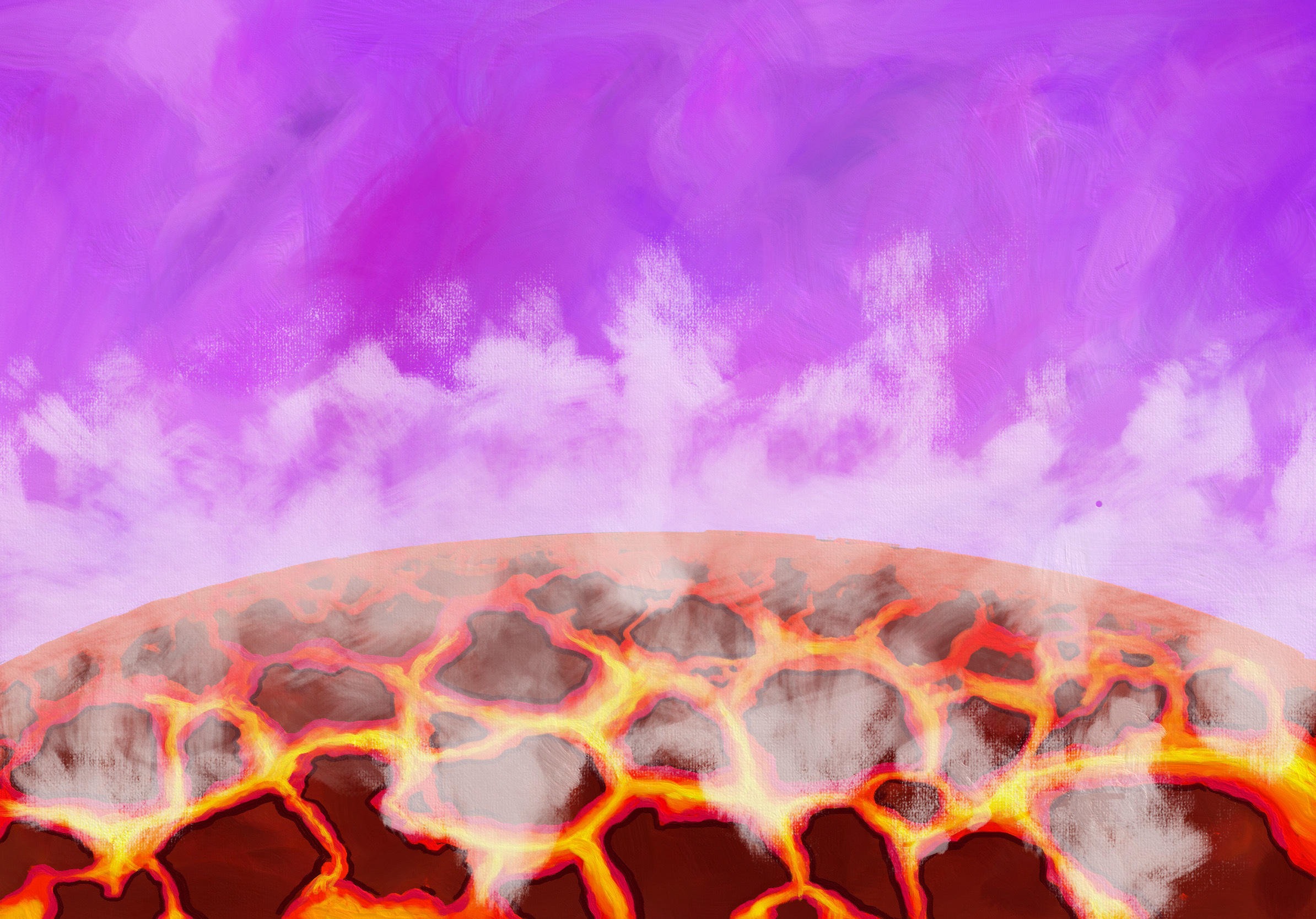
An artistic impression of the molten surface of a young planet interacting with its atmosphere to form water vapor. Credit: Tadahiro Kimura
A day at the beach is a lifetime on other planets.
According to new simulations, perfectly Earth-like exoplanets with oceans and continents, as well as beaches along their borders, may be more common around red dwarfs than previously thought. This indicates that by the end of the current and future decade[{” attribute=””>exoplanet survey missions can expect to discover several Earth analogs for further investigation.
The range of orbits around a star where the temperature would be suitable for an exoplanet to have liquid water on its surface is referred to as the “habitable zone.” This does not imply that there is life or even water on the planet. In reality, life on the majority of exoplanets in the habitable zone would not be “a day at the beach.”
On Earth, both the oceans and continents play critical roles in the geochemical carbon cycle, which helps to sustain a temperate climate with liquid water and life. So, in order to search for potentially habitable Earth-like planets, we need “a day at the beach,” where land and sea can coexist.
Previous research has cautioned that such beach-friendly worlds may be extremely rare, even in the habitable zones around the most common types of stars (namely red dwarfs). This is due to a significant difference in the water content of rocky materials found in the inner and outer parts of a protoplanetary disk where planets form, resulting in the creation of planets with either too much or too little water in most situations.
But new numerical simulations conducted by Tadahiro Kimura from the University of Tokyo and Masahiro Ikoma from the National Astronomical Observatory of Japan provide a sunnier view. By taking into consideration water produced from interactions between the still-molten surface of a young planet and its primordial atmosphere, the team found that a wide range in final water content is expected.
And within that range, several percent of roughly-Earth-sized planets in habitable zones should have appropriate amounts of water for a temperate climate. This is a high enough percentage that ongoing and future exoplanet survey missions like TESS and PLATO can expect to find multiple examples of truly Earth-like exoplanets with beaches in the 2020s.
Reference: “Predicted diversity in water content of terrestrial exoplanets orbiting M dwarfs” by Tadahiro Kimura and Masahiro Ikoma, 29 September 2022, Nature Astronomy.
DOI: 10.1038/s41550-022-01781-1
The study was funded by the Japan Society for the Promotion of Science.