

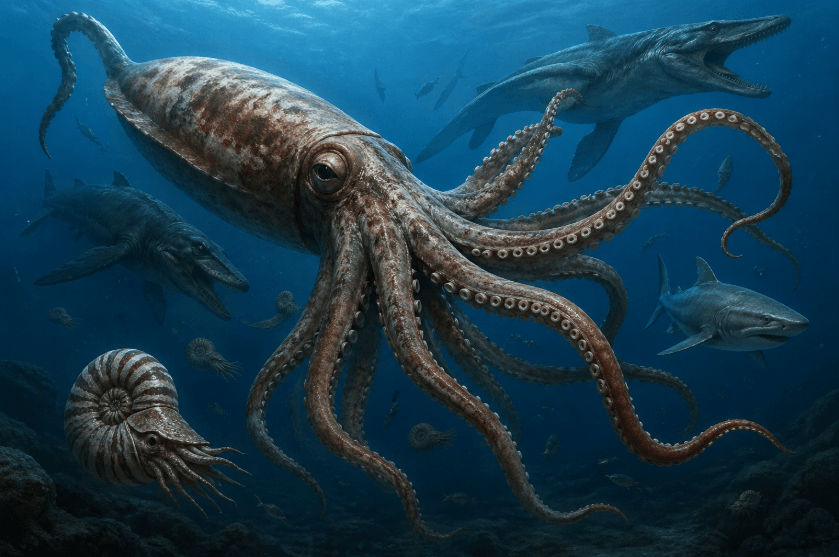
A massive, octopus-like predator stretching up to 60 feet long may have been one of the dominant hunters in Earth’s oceans during the age of dinosaurs, according to new research analyzing fossilized jaws. The findings challenge long-held assumptions about marine food chains in the late Cretaceous period, roughly 100 million years ago.
Fossil Evidence Points to Enormous Cephalopods
For decades, scientists have believed that prehistoric seas were dominated by formidable predators such as sharks and large marine reptiles, including mosasaurs and plesiosaurs. Octopuses, by contrast, have largely been left out of that narrative—mainly because their soft bodies rarely fossilize.
However, a new study highlights fossilized octopus jaws, or beaks, as key evidence. These structures, made of hardened chitin, are durable enough to survive over millions of years. Researchers examined 15 known fossil specimens from Japan and Canada’s Vancouver Island, along with 12 newly identified examples discovered using a technique called digital fossil mining. This method involves scanning rock layers in cross-section to reveal hidden fossils.
By comparing these ancient jaws to those of modern octopuses, scientists estimated that the prehistoric creatures ranged from about 23 to 62 feet in length—placing them among the largest invertebrates ever identified.
“The largest jaw we found is significantly bigger than that of any living octopus,” said study co-author Yasuhiro Iba, a paleontologist at Hokkaido University.
A Potential Apex Predator
The idea of an octopus rivaling top marine predators may seem surprising, but researchers say the evidence supports it. Wear patterns on the fossilized jaws—including scratches, chips, and rounded edges—suggest these animals frequently crushed hard prey such as shells and bones.
That feeding behavior indicates a powerful bite and a diet that may have included fish, mollusks, and possibly other marine animals. While direct evidence of their prey remains limited—no stomach contents have been preserved—the damage observed on the jaws points to repeated, forceful feeding.
“Until now, the largest known invertebrate has been the modern giant squid, which can reach about 39 feet in length,” Iba said. “This predator appears to exceed that.”
Researchers suggest that these ancient cephalopods may have competed with vertebrate predators for food, placing them higher in the marine food chain than previously assumed.
Rethinking Ancient Ocean Ecosystems
The findings add to a growing body of research that challenges traditional views of prehistoric ecosystems. Scientists have often assumed that animals without backbones—known as invertebrates—played a lesser role in top-tier predation. But the structure and size of these fossilized jaws suggest otherwise.
“Our findings show that powerful jaws, combined with the loss of external skeletons, allowed cephalopods and marine vertebrates to evolve into large, intelligent predators independently,” the researchers wrote in the study, published in the journal Science.
Adiel Klompmaker, a paleontologist at the University of Alabama who was not involved in the research, described the creatures as “a fearsome sight to behold,” underscoring their potential impact on ancient marine life.
Gaps in the Fossil Record
Despite the compelling evidence, scientists caution that much remains unknown. Because octopus bodies are soft and rarely preserved, the fossil record is incomplete. Future discoveries—particularly in underexplored regions—could provide a clearer picture of how these animals lived and interacted with other species.
Neil Landman, a paleontologist at the American Museum of Natural History in New York, emphasized the importance of continued exploration.
“It’s a big planet,” he said. “There’s still a lot to uncover as we try to reconstruct ancient marine ecosystems.”
A Complicated Fossil History
The study comes amid ongoing revisions in the understanding of early cephalopods. Earlier this month, a fossil once believed to represent the world’s oldest octopus was reclassified after scientists determined it actually belonged to a different marine organism—a relative of the nautilus, which has both tentacles and a shell.
Such corrections highlight the challenges researchers face when studying soft-bodied animals through limited fossil evidence.
Conclusion
The discovery of massive, octopus-like predators adds a new dimension to our understanding of prehistoric oceans. While sharks and marine reptiles have long been viewed as the dominant hunters of the dinosaur era, these findings suggest that giant cephalopods may also have played a significant—and previously underestimated—role at the top of the food chain.