
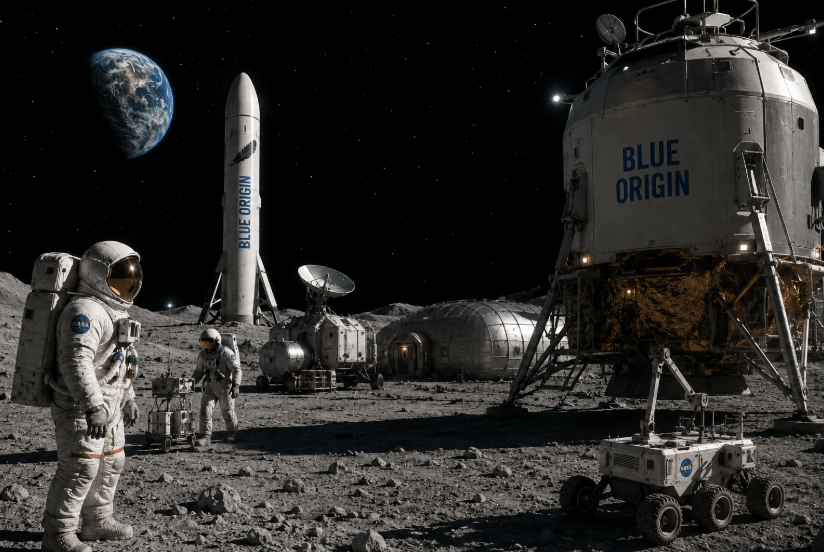
As interest in human space exploration continues to grow, NASA is focusing its immediate ambitions on the Moon rather than Mars. While SpaceX and Elon Musk have captured global attention with plans to establish a self-sustaining city on Mars, NASA’s latest strategy emphasizes a more practical first step: building a permanent human presence on the lunar surface.
The agency’s newest lunar development update reveals that the Moon is now at the center of NASA’s long-term exploration roadmap. Notably, the company playing a leading role in this effort is not SpaceX, but Blue Origin.
NASA’s Vision for a Permanent Moon Base
NASA recently outlined a phased approach for creating a sustainable lunar outpost near the Moon’s South Pole. The region has become a primary target because of its scientific value and the potential presence of water ice, a resource that could support future human missions.
The first phase of the program is scheduled to run through 2029 and will focus on laying the groundwork for long-term operations on the Moon.
Up to 25 Missions Planned by 2029
As part of this initial phase, NASA plans to conduct as many as 25 missions and 21 lunar landings. These missions are designed to test critical technologies, evaluate potential landing and settlement locations, and establish the infrastructure required for a lasting human presence.
The program will also help scientists and engineers develop systems for living and working in one of the harshest environments humans have ever attempted to inhabit.
Blue Origin Emerges as a Key Lunar Partner
One of the most surprising aspects of NASA’s lunar strategy is the prominent role being played by Blue Origin. Although SpaceX remains heavily involved in NASA’s broader exploration efforts, Blue Origin has emerged as a leading participant in the agency’s plans to establish a foothold on the Moon.
The development marks a significant moment in the commercial space industry, where multiple private companies are competing to support government-led missions beyond Earth.
Building Toward Future Mars Missions
NASA views the Moon as an essential stepping stone for deeper space exploration. Before astronauts can safely undertake the months-long journey to Mars, the agency wants to gain experience operating in a sustained off-world environment much closer to Earth.
A lunar base would allow crews to test life-support systems, resource utilization technologies, habitat construction methods, and other capabilities needed for future missions to the Red Planet.
The knowledge gained from long-term lunar operations could significantly reduce the risks associated with interplanetary travel and help shape the next generation of human space exploration.
The Next Chapter of Space Exploration
NASA’s latest plans demonstrate a clear shift from short-term lunar visits to the goal of permanent habitation. With dozens of missions planned over the coming years and Blue Origin taking a central role in the effort, the agency is moving closer to establishing a lasting human presence beyond Earth.
While Mars remains a long-term objective, NASA’s current focus suggests that humanity’s next major milestone in space may begin on the Moon. A successful lunar base could serve as both a scientific hub and a launchpad for future journeys deeper into the solar system.