
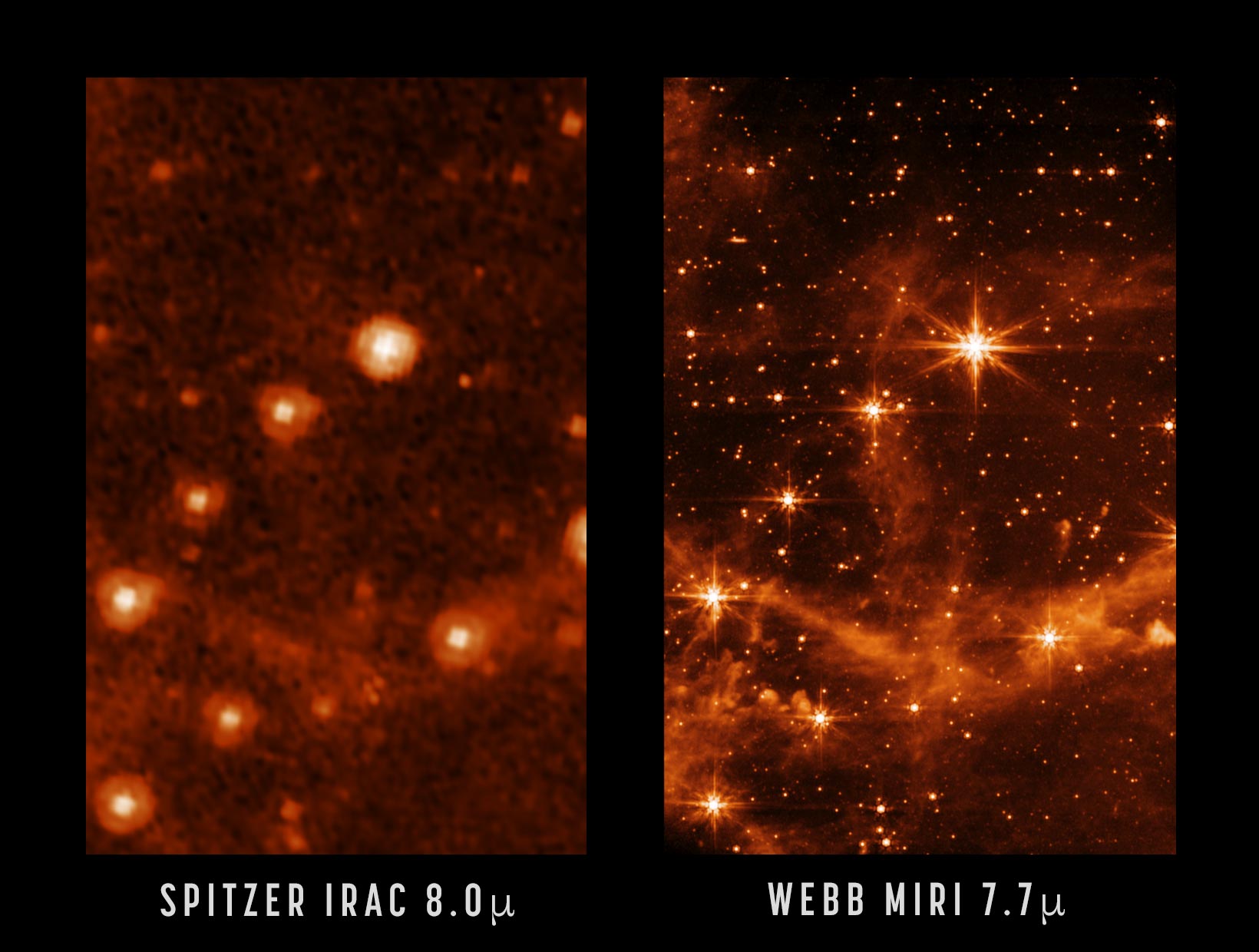
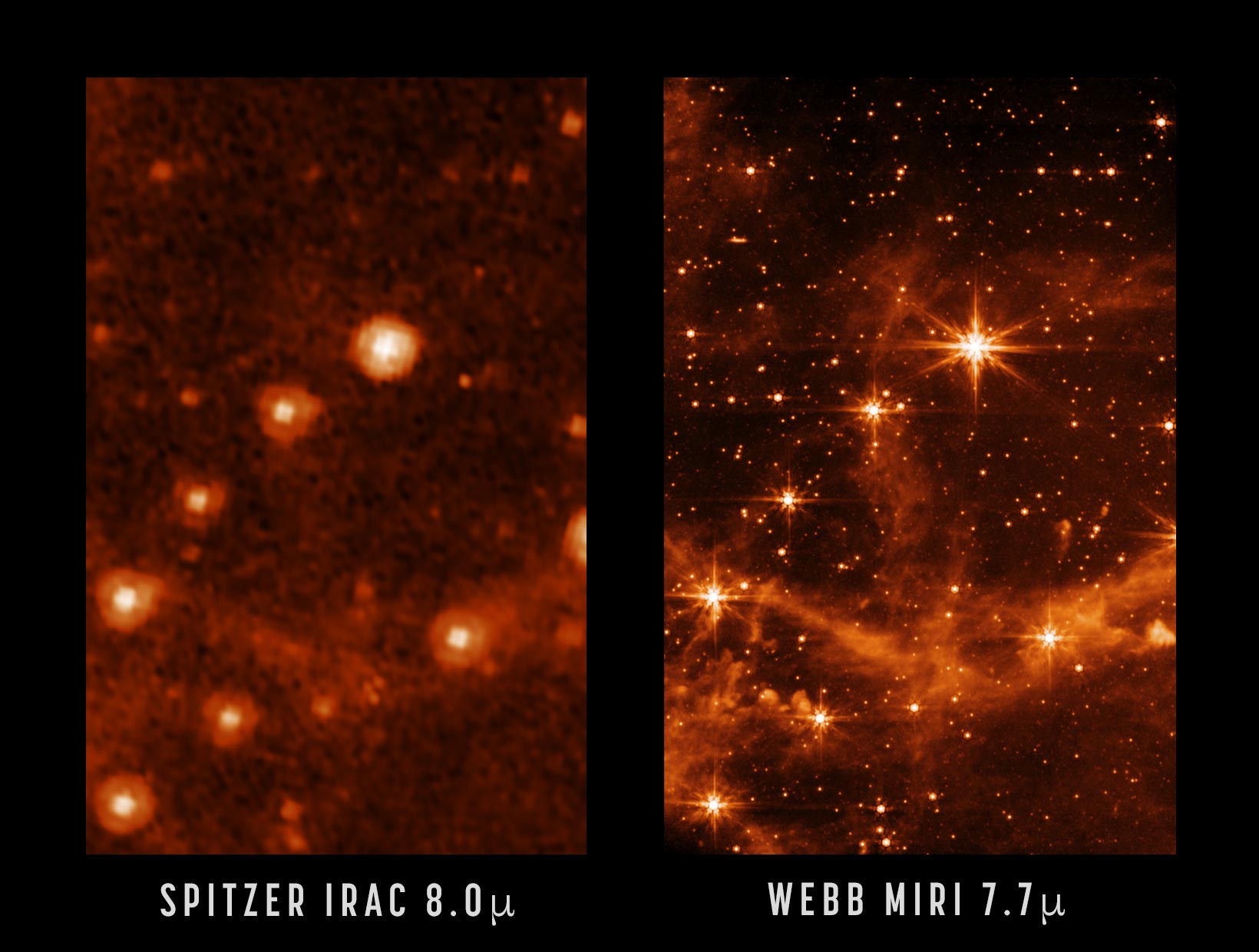
Comparison of the Webb Space Telescope and a mid-infrared instrument image of the Large Magellanic Cloud and a previous image of the same view using the Spitzer Space Telescope’s Infrared Array Camera. Credit: NASA/JPL-Caltech (left), NASA/ESA/CSA/STScI (right)
James Webb Space Telescope is aligned across all four of its science instruments, as seen in a previous engineering image showing the observatory’s full field of view. Now, we take a closer look at that same image, focusing on Webb’s coldest instrument: the Mid-Infrared Instrument, or MIRI.
The MIRI test image (at 7.7 microns) shows part of the Large Magellanic Cloud (LMC). This small satellite galaxy of the Milky Way, located about 160,000 light-years away, provided a dense star field to test Webb’s performance.
Here, a close-up of the MIRI image is compared to a past image of the same target taken with NASA’s Spitzer Space Telescope’s Infrared Array Camera (at 8.0 microns). The retired Spitzer telescope was one of NASA’s Great Observatories and the first to provide high-resolution images of the near- and mid-infrared universe. Webb, with its significantly larger primary mirror and improved detectors, will allow us to see the infrared sky with improved clarity, enabling even more discoveries.
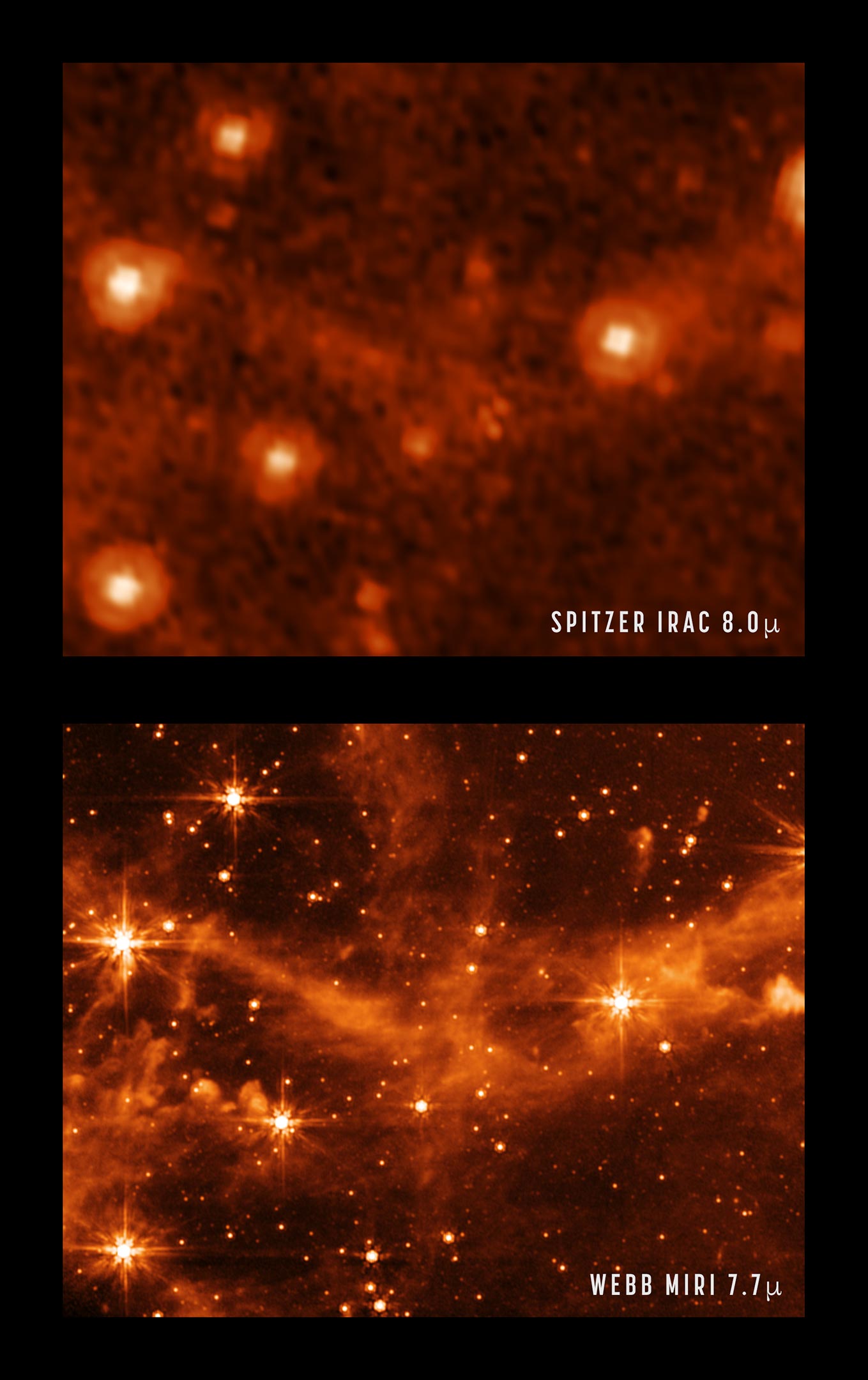
Comparison of a Webb MIRI image of the Large Magellanic Cloud and a past image of the same view using the Spitzer IRAC. Credit: NASA/JPL-Caltech (top), NASA/ESA/CSA/STScI (bottom)
For example, Webb’s MIRI image shows the interstellar gas in unprecedented detail. Here, you can see the emission from “polycyclic aromatic hydrocarbons,” or molecules of carbon and hydrogen that play an important role in the thermal balance and chemistry of interstellar gas. When Webb is ready to begin science observations, studies such as these with MIRI will help give astronomers new insights into the birth of stars and protoplanetary systems.
In the meantime, the Webb team has begun the process of setting up and testing Webb’s instruments to begin science observations this summer.
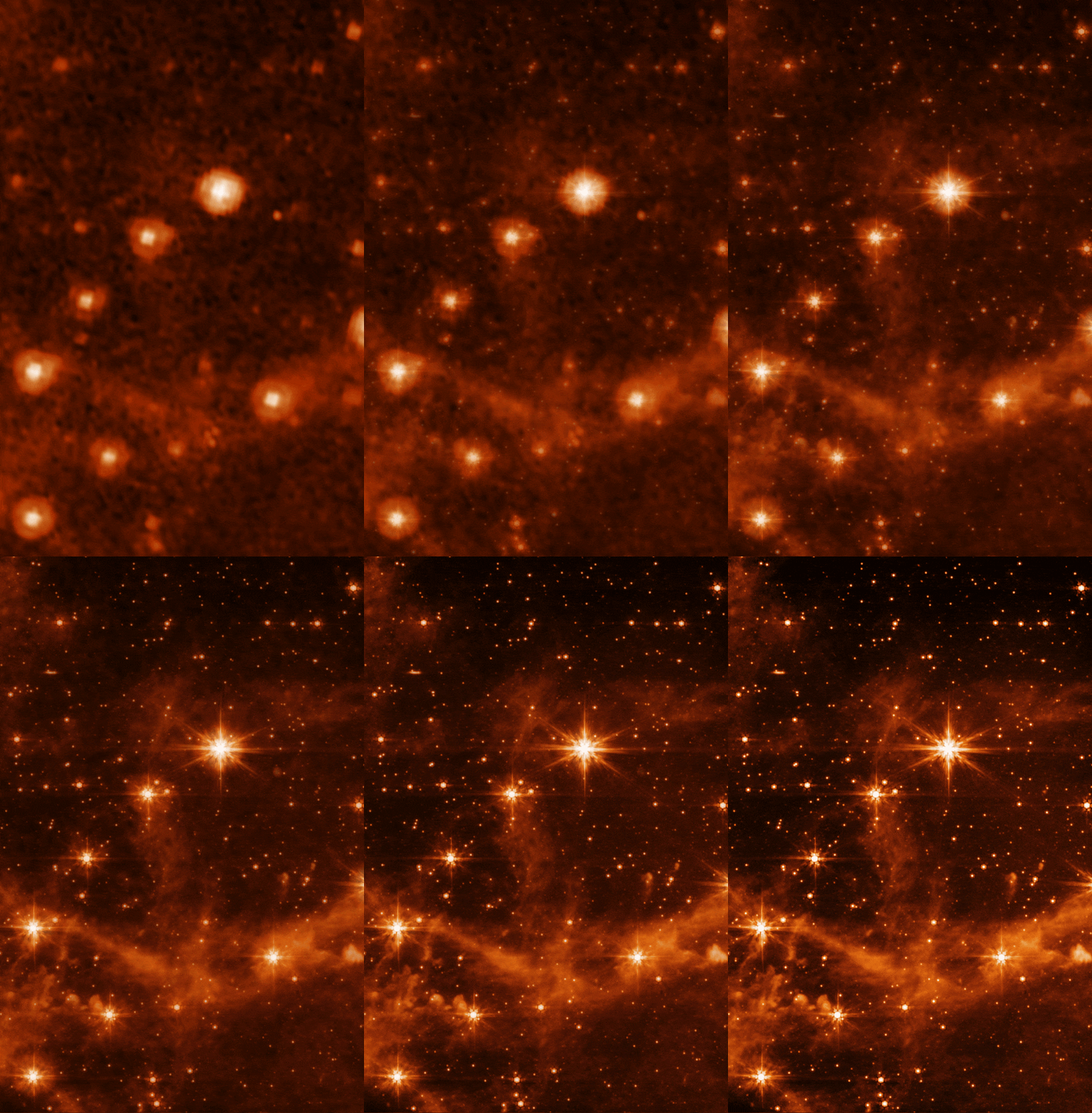
Credit: NASA/ESA/CSA/STScI
The James Webb Space Telescope is an international partnership between NASA, the European Space Agency (ESA), and the Canadian Space Agency (CSA). MIRI is part of Europe’s contribution to the Webb mission. It is a partnership between Europe and the USA; the main partners are ESA, a consortium of nationally funded European institutes, the Jet Propulsion Laboratory (JPL), and NASA’s Goddard Space Flight Center (GSFC).