

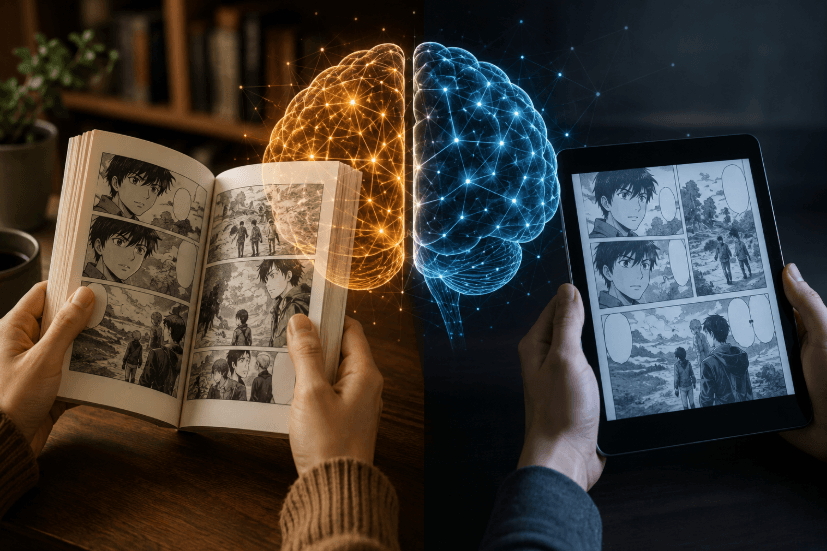
A new neuroscience study suggests that reading physical books may help the brain process and connect information more efficiently than reading on digital devices. Researchers found that people who read comic-style narratives on paper required less mental effort to recall and integrate story details later compared with readers using tablets.
The findings, published in the journal PLOS ONE, add to growing research examining how digital reading habits may influence memory, comprehension, and cognitive workload in an increasingly screen-focused world.
How the Brain Organizes Stories
Reading involves far more than recognizing words and images. The brain constantly organizes characters, timelines, emotions, and visual details into what scientists describe as a “story schema” — a mental framework that helps readers follow and remember a narrative.
Researchers believe physical books may support this process through stable sensory cues. Readers can feel the thickness of pages, remember where information appeared on a page, and physically track progress through a story. Digital screens, by contrast, display changing text on a mostly identical surface, offering fewer tactile or spatial reference points.
To investigate whether these differences affect brain activity, neuroscientists at the University of Tokyo focused on Japanese manga, a storytelling format that combines detailed visuals with emotionally layered narratives.
Research Inspired by the Publishing Industry
According to lead researcher Kuniyoshi L. Sakai, a professor in the Department of Basic Science at the University of Tokyo’s Graduate School of Arts and Sciences, the study began after manga publisher COAMIX INC. asked whether the benefits of paper books could be scientifically measured.
“This research project began with an inquiry from COAMIX INC., one of the major publishers of Japanese manga, whether we could investigate any values of paper books scientifically,” Sakai explained.
“As a neuroscientist working on the human brain, especially on its language function, I decided to compare brain activation between paper and digital reading.”
How Scientists Measured Brain Activity
The research team faced a technical challenge because MRI scanners use powerful magnets, making it impossible to bring electronic tablets into the scanning room.
“When comparing a paper book and an electronic tablet, we cannot bring the latter device into the scanning room, because the scanner is a huge magnet,” Sakai said.
Researchers instead measured brain activity after participants completed their reading sessions outside the scanner.
The study involved 25 right-handed university students who were native Japanese speakers. Participants read the first half of a manga story either on paper or on a tablet. The manga was carefully selected because each story was divided into two halves that showed the same events from different emotional perspectives, allowing scientists to examine how readers combined multiple viewpoints into a coherent understanding.
The researchers controlled environmental conditions closely. The physical books and tablets were similar in size, and lighting levels were adjusted so the reflected light from the paper closely matched the brightness of the tablet screens.
After reading the first half of the story, participants entered the MRI scanner and used digital goggles to read the second half. During the reading process, they periodically rated their empathy toward the characters to confirm they remained engaged with the narrative.
Participants then answered multiple-choice questions about the story while still inside the scanner.
Paper Readers Needed Less Mental Effort
Both groups answered the questions with similar accuracy, but important differences appeared in response times.
Participants who initially read the story on tablets took longer to answer more difficult questions that required combining details from both halves of the narrative. Researchers concluded that tablet readers needed additional cognitive effort to integrate the information.
Brain scans revealed similar patterns.
Readers who started with physical books showed reduced activity in areas such as the left lateral premotor cortex and inferior frontal gyrus — regions heavily involved in language processing and narrative integration. Lower activation in these regions generally indicates that the brain is working more efficiently.
Tablet readers, however, displayed stronger activation in the same regions. They also showed increased activity in right frontal brain areas associated with supporting demanding mental tasks.
“We found that both left and right hemispheres, which work during reading mostly for proper linguistic functions and supportive roles, respectively, are less engaged when manga contents are well understood through reading on paper, compared with digital reading,” Sakai said.
Researchers also observed heightened activity in the right angular gyrus among tablet readers. This region is linked to spatial processing, suggesting digital readers may have been working harder to mentally reconstruct the layout and sequence of comic panels.
Digital Reading Still Supports Learning
The researchers emphasized that the findings do not suggest digital reading prevents learning or comprehension. Tablet readers ultimately understood the material as accurately as paper readers. The key difference was that they appeared to require more time and mental effort to achieve the same result.
Several factors may contribute to this effect. Turning physical pages creates subtle pauses that may help the brain process information, while the tactile structure of a printed book may provide a stronger mental map of the narrative. Tablet screens also use emitted backlight rather than reflected ambient light, which could influence reading rhythms and concentration.
Although the experiment focused on manga, Sakai believes the results would likely apply to novels and other text-based formats because narrative comprehension relies on similar mental processes.
“One important advantage of using manga stories is that manga has visual narratives, which provide rich pictorial information that facilitates the comprehension of scenes,” he noted.
Future Research Will Explore Writing and Digital Interaction
Researchers say future studies will investigate additional differences between paper-based and digital interaction, including handwriting versus typing.
“Using a similar method, we are now examining any effects of writing with a pen or a keyboard,” Sakai said. “This would be a natural next step for comparing paper and electronic devices.”
As digital devices continue to dominate education, entertainment, and daily communication, the study provides fresh insight into how physical books may still offer unique cognitive advantages — particularly when readers are processing complex narratives and retaining detailed information.