

Scientists may have finally solved one of botany’s most fascinating puzzles: how the Venus flytrap launches the rapid motion that allows it to trap insects in a fraction of a second. New research from France provides fresh insight into the mechanics behind the plant’s famous snap, overturning one long-standing theory while strengthening another.
The findings, published in the journal Science, could also influence the development of soft robotics and advanced materials designed to move without motors or muscles.
Venus Flytraps Use a Unique Hunting Strategy
The Venus flytrap (Dionaea muscipula) has long stood out as one of the most unusual plants on Earth. Native to nutrient-poor wetlands in the southeastern United States, particularly North and South Carolina, the carnivorous plant survives by capturing and digesting insects.
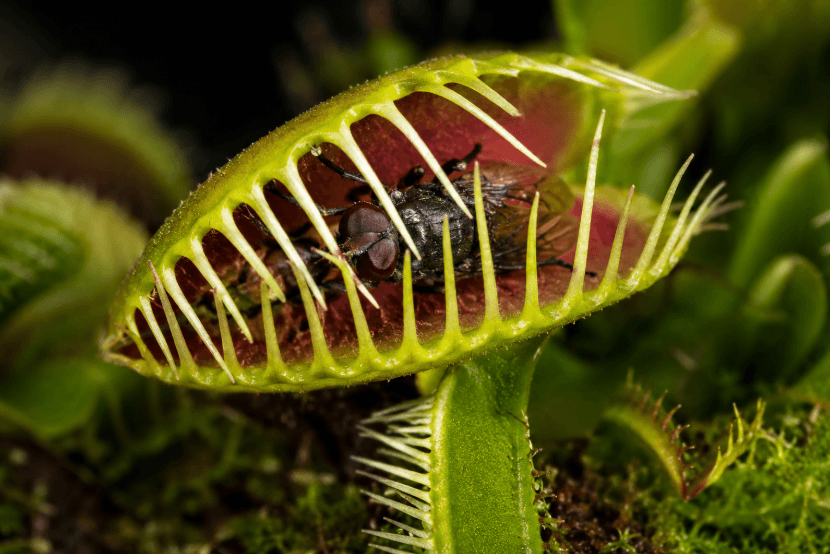
Its trap consists of two hinged lobes lined with tiny sensory hairs. When an insect touches these hairs multiple times, the plant reacts by snapping the lobes shut, imprisoning the prey inside. Digestive enzymes then break down the insect into nutrients the plant can absorb.
Unlike animals, however, the Venus flytrap performs this rapid movement without muscles or nerves, making its mechanism especially intriguing to scientists.
New Study Challenges Previous Theory
Researchers at Aix-Marseille University examined the plant’s trap at close range to determine what triggers the initial closing motion. For years, scientists debated between two main explanations.
One hypothesis suggested that water rapidly shifted into cells on the outer layer of the trap, creating pressure that forced the lobes to close — similar to pushing a door shut.
The second theory proposed that the outer cell walls suddenly relaxed, releasing stored elastic energy much like a compressed spring snapping free.
To test these ideas, the team led by Jeongeun Ryu monitored the plant’s cells as the trap began closing.
Cell Walls Appear to Trigger the Snap
The researchers discovered that water movement between cells occurred too slowly to explain the trap’s near-instant response.
Instead, they observed what they described as a rapid “softening” of the outer epidermal cell walls lasting roughly one second. This softening released elastic energy already stored in the trap structure, causing the lobes to snap inward.
According to the study, the mechanism represents one of the fastest changes in plant cell wall mechanics ever recorded.
“Our findings establish the Venus flytrap not only as a key model for fast plant signaling but also as a powerful system to study dynamic cell wall mechanics,” the researchers wrote.
A Breakthrough for Plant Biology
The discovery adds to a growing body of research explaining how Venus flytraps function.
Previous studies revealed that the plants can effectively “count” touches inside the trap, helping distinguish prey from accidental contact such as raindrops or falling debris. Other research identified signaling processes that alert the entire plant when it is time to close.
Until now, however, scientists had not fully understood the physical process that initiated the movement itself.
The latest findings help close that knowledge gap and provide a clearer picture of how plants can execute rapid movements despite lacking the biological systems associated with animals.
Potential Applications in Robotics
Beyond plant biology, the research may have implications for engineering and materials science.
Scientists say the Venus flytrap’s ability to move quickly through changes in cell wall flexibility could inspire new forms of soft robotics — machines designed to bend, grip, or move without rigid mechanical parts.
Researchers are increasingly studying biological systems to create more adaptable robotic technologies for fields ranging from medicine to manufacturing.
The study’s authors noted that further research will still be needed to determine the exact molecular process responsible for the rapid softening of the plant’s cell walls.
Carnivorous Plants Still Hold More Secrets
The Venus flytrap is only one member of a diverse group of carnivorous plants. Other species use slower trapping methods that may rely more heavily on water movement rather than elastic energy.
Comparing these plants could provide scientists with a deeper understanding of how different trapping strategies evolved over millions of years.
Jacques Dumais, a plant biophysicist not involved in the study, said the new findings help explain how complex plant adaptations can emerge gradually through evolution.
“By clarifying the importance of wall relaxation in driving the closure of the Venus flytrap, Ryu et al. have filled a large gap in the current understanding of how such intricate adaptations can arise from a piecemeal evolutionary process,” Dumais wrote in an editorial accompanying the study.
Conclusion
The Venus flytrap has fascinated scientists and the public alike for generations, serving as one of nature’s most remarkable examples of rapid plant movement. With this latest study, researchers appear to have identified the trigger behind the plant’s iconic snap, offering new insight into both evolution and the hidden mechanics of plant life. The findings may eventually influence technologies far beyond the greenhouse, including the next generation of flexible robotics and smart materials.