

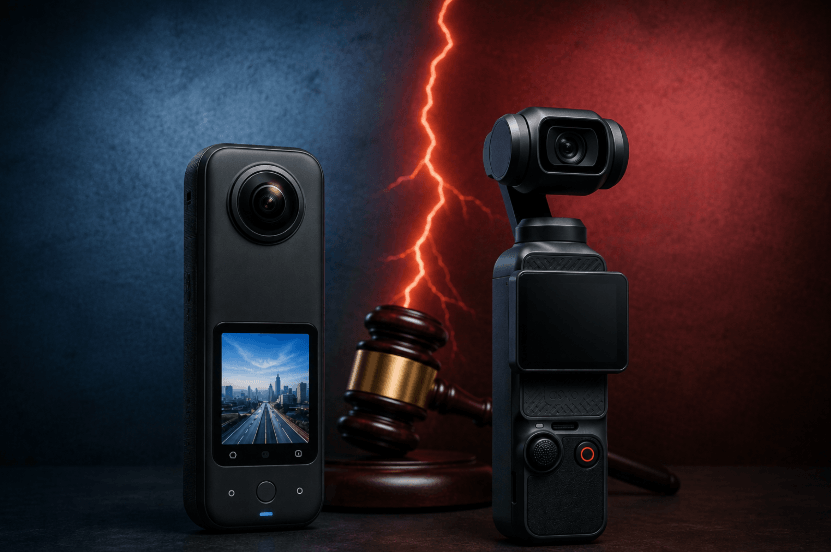
The rivalry between Insta360 and DJI has intensified after Insta360 filed countersuits in the United States accusing DJI of infringing five utility patents tied to camera stabilization and 360-degree imaging technology.
The legal dispute highlights the growing competition in the creator-tech market, where companies are racing to dominate compact cameras, handheld gimbals, and immersive video systems used by vloggers, filmmakers, and social media creators.
Insta360 Files Countersuits Against DJI
Insta360 announced that it has filed two countersuits against DJI, claiming the company violated patents connected to several core technologies used in gimbal and panoramic cameras.
According to Insta360, the disputed technologies involve gimbal stabilization, directional control systems, smooth camera stabilization, telemetry overlays, and panoramic video stabilization. The company alleges these features appear in several DJI product lines, including the Osmo Pocket, Ronin and RS stabilizers, Osmo Mobile devices, and the Osmo 360.
The countersuits were filed shortly after DJI launched legal action against Arashi Vision Inc., the company behind Insta360, over its newly introduced Luna Ultra gimbal camera.
DJI’s lawsuits allege that the Luna Ultra infringes on two design patents and four utility patents. The company claims the device closely resembles the design and functionality of the Osmo Pocket 3, one of DJI’s best-known handheld cameras.
Insta360 Rejects the Allegations
Insta360 said it “categorically rejects” DJI’s infringement claims and maintains that the Luna Ultra was independently developed through years of research and engineering.
“At Insta360, we prefer to let our products do the talking. But we are not afraid of a legal battle when challenged,” said Insta360 founder JK Liu.
The company added that it is committed to defending its intellectual property and protecting technologies it believes are being used without authorization.
Luna Ultra at the Center of the Dispute
The Luna Ultra enters a rapidly expanding segment of the consumer electronics market focused on portable video production and creator-focused imaging tools.
Insta360 argues that DJI’s lawsuits are intended to disrupt the U.S. launch of the Luna Ultra by seeking a permanent injunction that could potentially block sales of the device in the American market.
Liu said the timing of DJI’s filings — arriving on the same day as the Luna Ultra launch — reflects concern over increasing competition.
“Luna Ultra is the result of years of independent R&D, not a response to any competitor’s product,” Liu said.
According to Insta360, development on the camera began in 2020. The company also pointed to earlier products, including the ONE R camera lineup, Link Series webcams, and Flow Series gimbals, as part of the technological foundation behind the Luna Ultra.
Competition Intensifies in the Creator Camera Market
The dispute reflects broader trends across the consumer imaging industry, where companies are aggressively protecting patents tied to stabilization systems, AI-powered video tools, and immersive camera technologies.
DJI has long maintained a dominant position in the drone and handheld gimbal market, particularly in North America and Europe. Meanwhile, Insta360 has rapidly expanded its presence through 360-degree cameras and creator-focused accessories aimed at travel, sports, and social media content production.
Patent battles are increasingly common in the technology sector, especially as hardware design and software-based imaging features continue to overlap across competing devices.
Legal Conflict Continues to Grow
The latest filings add to an ongoing legal conflict between the two companies. Earlier this year, DJI also sued Insta360 over alleged infringement related to drone image-processing technology.
Neither company has publicly indicated a willingness to settle, suggesting the dispute could continue through extended court proceedings in the United States.
While the lawsuits are unlikely to immediately affect consumers, the outcome could shape competition in the fast-growing market for compact cameras, gimbals, and creator-focused video technology.
As both companies continue expanding internationally, the case underscores how intellectual property disputes have become a major battleground in the race to lead the next generation of imaging technology.