

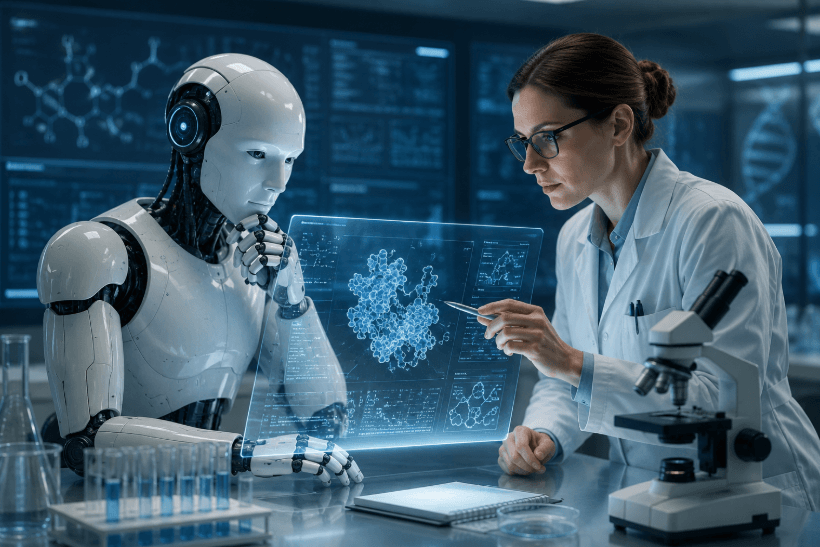
Artificial intelligence is rapidly reshaping scientific research, promising faster discoveries, streamlined workflows and new ways to tackle complex diseases. But as AI-powered research systems become more sophisticated, a central question is emerging across laboratories and universities: can science truly advance without human judgment, creativity and ethical oversight?
Recent breakthroughs in AI-assisted molecular biology suggest that machine-driven discovery is accelerating. Yet they also reinforce a critical reality — scientific progress still depends heavily on human insight, collaboration and experience.
AI Systems Are Taking on Bigger Research Roles
Two recent studies published in the journal Nature highlight how AI agents are beginning to perform tasks once handled almost entirely by researchers.
In one project, scientists at FutureHouse in San Francisco developed an AI system called Robin to investigate treatments for dry age-related macular degeneration, a leading cause of vision loss among older adults in the United States.
Robin searched scientific literature, generated therapeutic hypotheses, identified potential drug molecules and selected laboratory tests for evaluation. Human researchers then carried out the experiments and returned the results to the AI system for further analysis and follow-up recommendations.
According to the research team, the system shortened the project timeline dramatically compared with conventional drug-discovery methods.
Google’s AI Co-Scientist Tackles Disease Research
A separate team led by researchers at Google introduced an AI-agent platform known as Co-Scientist. The system was used to identify existing drugs that might be repurposed to treat certain forms of leukemia and to uncover potential drug targets for liver fibrosis.
The researchers also tasked the AI with solving a long-standing biological puzzle involving antibiotic resistance genes shared across multiple bacterial species. Scientists had spent nearly a decade exploring the issue. The AI system independently arrived at the same hypothesis within days.
The achievement underscores how AI tools can rapidly process massive volumes of scientific literature and data — a task increasingly difficult for human researchers as global research output expands each year.
Human Researchers Remain Central to Scientific Progress
Despite the excitement surrounding these developments, neither AI system operated independently.
Human scientists designed the research goals, supervised experiments, evaluated findings and guided decision-making throughout the process. That collaboration was not simply a safeguard; it was fundamental to the projects’ success.
AI systems can analyze data at extraordinary speed, but scientific discovery involves more than efficiency. Researchers must determine which questions matter, recognize flawed assumptions and interpret results within broader social, medical and ethical contexts.
The Problem of AI Hallucinations and Misinterpretation
One major concern is reliability.
AI systems are still vulnerable to hallucinations — fabricated or inaccurate outputs that appear convincing. In scientific research, even minor errors in data interpretation could lead to wasted resources, flawed studies or dangerous medical conclusions.
Human oversight remains essential to verify findings, ensure data quality and confirm that experiments are conducted appropriately. Drug development, in particular, requires rigorous testing standards, regulatory review and ethical accountability that cannot simply be automated.
Researchers also note that creating a fully autonomous AI scientist would require far more advanced coordination among interconnected AI agents. Long-term scientific projects often involve years of refinement, shifting priorities and unexpected setbacks — areas where human adaptability still plays a major role.
Scientific Discovery Depends on Human Curiosity
Many of history’s most important breakthroughs emerged not from perfectly optimized systems, but from curiosity, persistence and even accidental discoveries.
Scientific expertise is often built over decades through mentorship, failed experiments and collaborative problem-solving. Human researchers develop intuition that cannot easily be reduced to data patterns or algorithmic logic.
That “messiness” in science — the willingness to pursue unconventional ideas, challenge assumptions or explore unexpected results — has repeatedly driven innovation in medicine, physics and technology.
AI may improve efficiency in laboratories, but efficiency alone does not necessarily produce deeper understanding.
Concerns About the Future of Research
The rapid expansion of AI in science is fueling broader debate within the research community.
Supporters argue that AI tools could accelerate medical breakthroughs, reduce repetitive laboratory work and lower the cost of developing treatments. In areas such as pharmaceutical research, where bringing a new drug to market can take more than a decade and cost billions of dollars, even modest improvements in efficiency could have major economic and public health benefits.
Critics, however, worry about the long-term consequences. Some fear that scientific literature could become flooded with low-quality AI-generated studies, while younger scientists may struggle to find training opportunities if automation replaces entry-level research work.
Others argue that science without human empathy and ethical judgment risks losing sight of the societal responsibilities that guide medical and technological progress.
AI and Human Scientists Are Likely to Work Together
Rather than replacing researchers, AI systems increasingly appear poised to become collaborative tools — powerful assistants that can accelerate analysis while leaving critical judgment to humans.
Scientists are unlikely to abandon AI-driven research altogether, particularly as global competition in biotechnology and pharmaceuticals intensifies. At the same time, many researchers are urging policymakers, universities and funding organizations to recognize that scientific advancement still depends on human expertise.
The future of discovery may ultimately rely not on choosing between humans and AI, but on finding the right balance between computational power and human wisdom.
As AI continues to transform research, one lesson is becoming increasingly clear: science still needs humanity as much as it needs technology.