
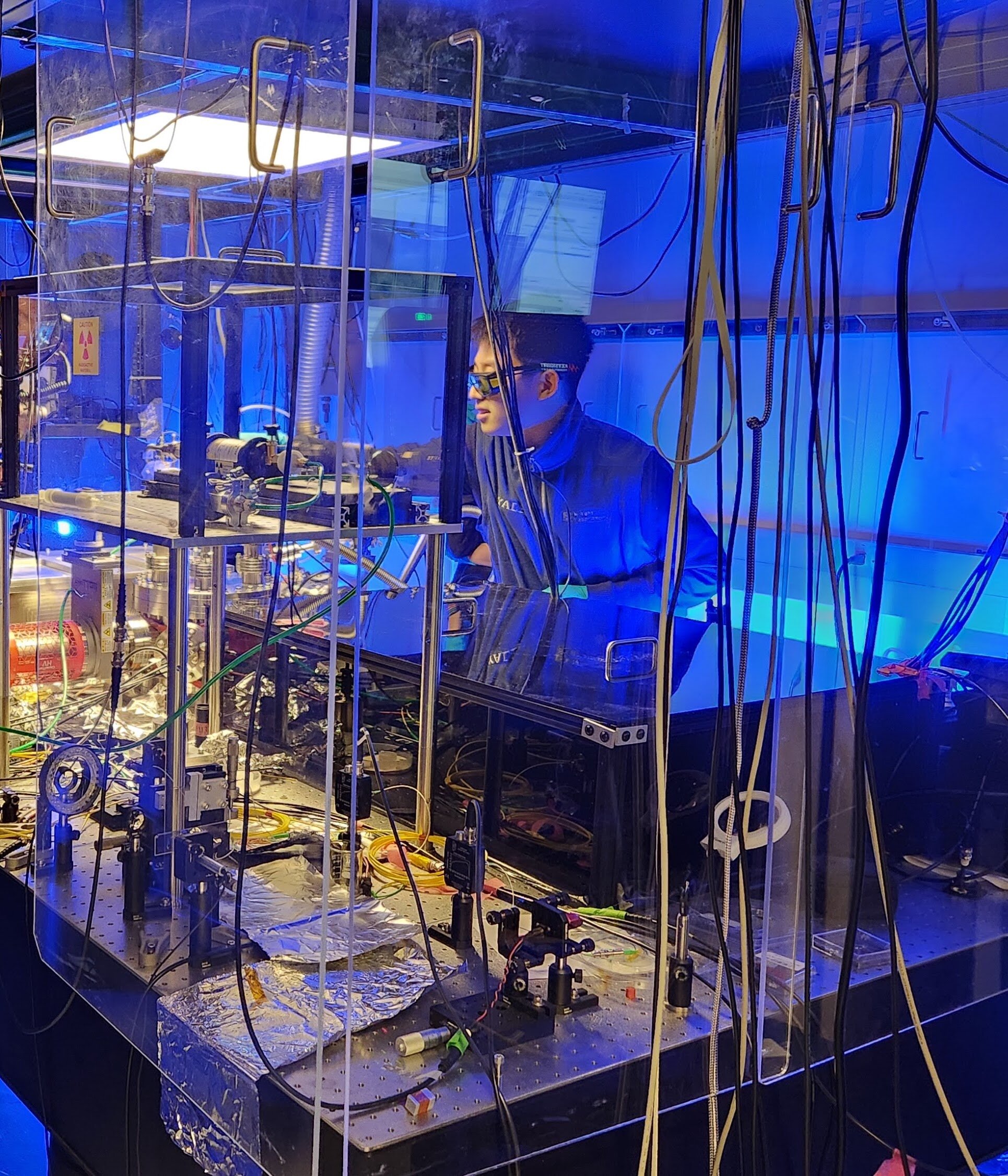
Graduate student Jia Xiang Wang works on the optical trap used in this work. Copyright: Yale Wright Lab.
In recent years, physicists and engineers have developed increasingly sophisticated tools to study particles and the interactions between them with high precision. These tools, which include particle detectors, sensors, and accelerometers, can help researchers study physical processes in greater detail, potentially leading to exciting new discoveries.
Researchers at Yale University have recently presented a new method for mechanically detecting single nuclear decay, the process by which an unstable atomic nucleus loses energy by emitting radiation. The proposed approach, described in paper in Physical Review Letterssensitive to all particles emitted during decay, including neutral particles, which are difficult or impossible to detect using current methods.
“Our group has been developing sensitive micron-scale force sensors and accelerometers using optically trapped particles in a vacuum,” David C. Moore, a co-author of the paper, told Phys.org. “Recently, the sensitivity of these systems has become so good that we realized that we could detect forces exerted by a single fundamental particle, such as an alpha particle emitted in nuclear decay.”
The main goal of Moore and his colleagues’ recent research was to develop new techniques for detecting nuclear decays using the forces imparted by individual fundamental particles. Such techniques would eventually allow them to detect particles that carry no electrical charge (i.e., neutral particles), which can be particularly difficult to detect with conventional detectors.
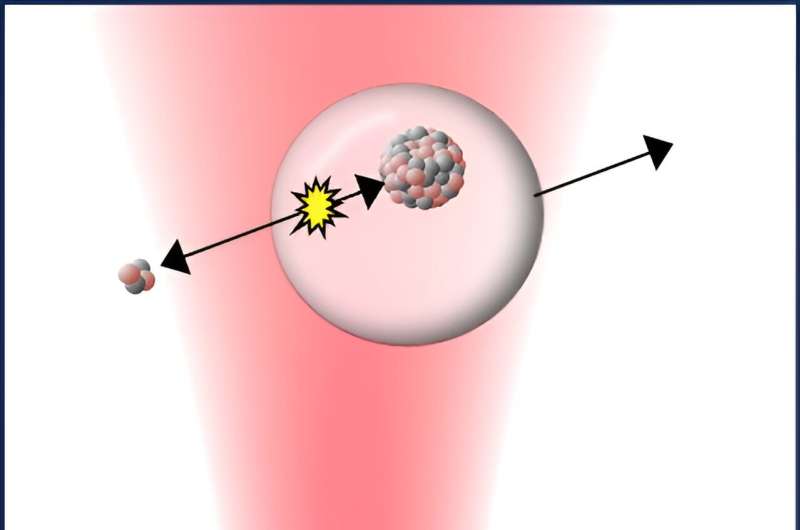
An optically trapped microscopic sphere recoils as an alpha particle emitted by a single nucleus decays inside it. Copyright: Yale Wright Laboratory.
“Our approach is to observe the motion of a single dust-sized particle, into which radioactive nuclei are implanted,” Moore explained. “If just one nucleus of the dust particle decays, we can detect this by observing a change in the particle’s electrical charge as charged particles such as alpha or beta particles escape.”
In their initial experiments, the team showed that their method could detect individual nuclear decays. Notably, the researchers were also able to observe the entire particle recoil at a fine scale of tens of nanometers, by carefully measuring the position of the sphere in their setup from the laser light that scattered off it.
“Our approach allows us to detect individual decays that occur within particles even if they occur very rarely, for example, only once a day,” Moore said. “This could allow us to study dust-sized particles relevant to nuclear weapons control and nonproliferation and detect individual decays of long-lived isotopes.”
This work could soon open up interesting avenues for particle physics research. For example, its promising detection method could be used in the search for dark matter and exotic particles, or it could lead to advances in the study of nuclear processes and neutral particles that elude conventional detectors.
“In our future work, we aim to extend the same techniques to even smaller nanoparticles,” Moore added. “This will allow us to detect the momentum of a single neutrino escaping the sphere. Neutrinos interact so weakly that they would otherwise have escaped undetected, but this new technique could provide new tools for studying these elusive particles.”
more information:
Jia Xiang Wang et al., Mechanical detection of nuclear decays, Physical Review Letters (2024). doi: 10.1103/PhysRevLett.133.023602. on Arcxiv: doi: 10.48550/arxiv.2402.13257
© 2024 Science Network X
the quotePhysicists propose method for mechanical detection of individual nuclear decays (2024, July 26) Retrieved July 26, 2024 from https://phys.org/news/2024-07-physicists-method-mechanical-individual-nuclear.html
This document is subject to copyright. Apart from any fair dealing for private study or research purposes, no part of it may be reproduced without written permission. The content is provided for informational purposes only.