
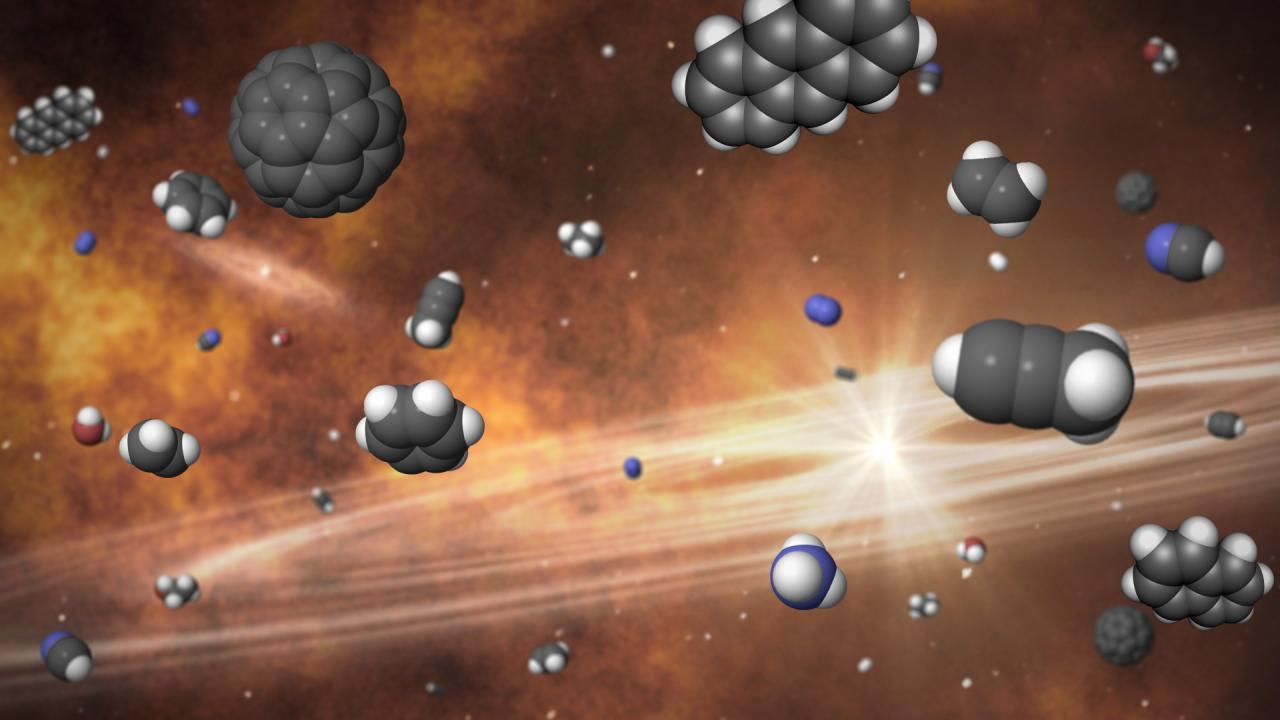
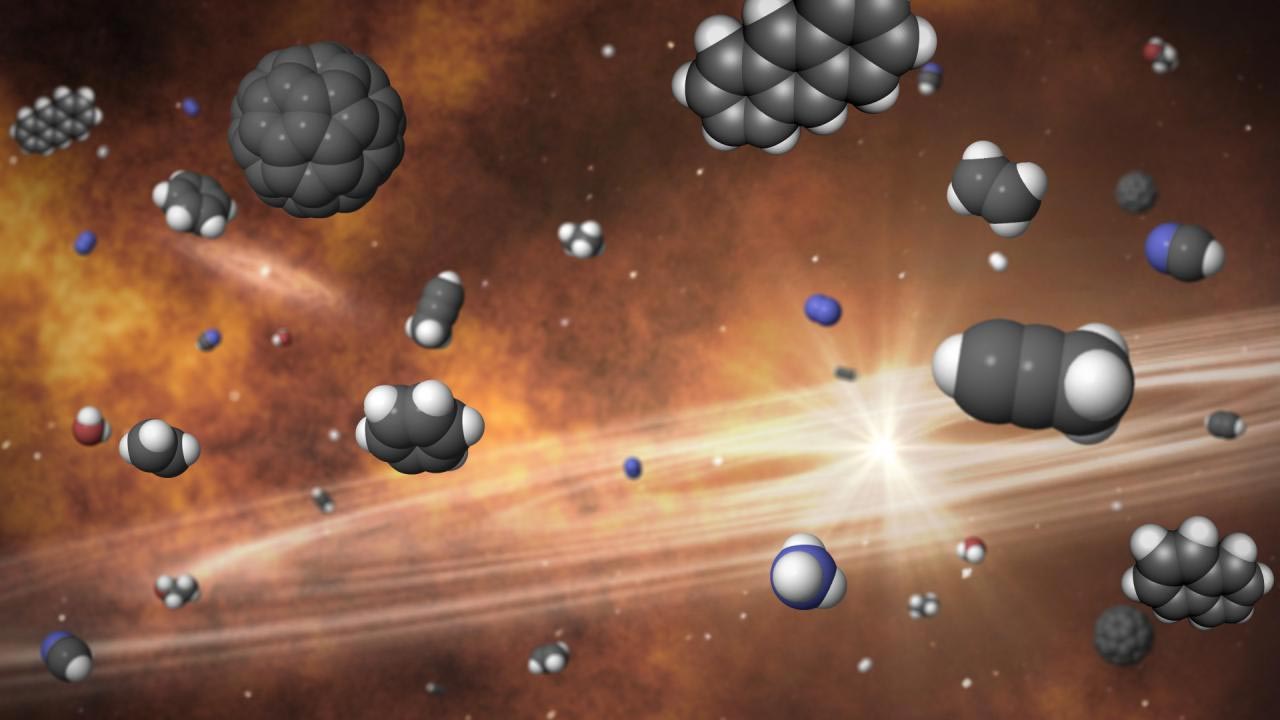
Artist’s composition of a ‘soup’ of prebiotic particles around a protoplanetary disk. Credit: Gabriel Perez Diaz (IAC)
A study conducted by researcher Susana Iglesias of the Astronomy Institute of Space in the Canary Islands revealed the presence of large quantities of complex organic molecules in one of the closest star-forming regions to the solar system. The results of this have been published in the journal Monthly Notices of the Royal Astronomical Society.
Scientists Suzanne Iglesias-Groth, from the Canary Islands Astronomy Institute (IAC) and Martina Marin-Dobrenic, from the Polytechnic University of Cartagena, discovered several prebiotic molecules in the star-forming region IC348 of the Perseus molecular cloud, a young star cluster around the age of About 2-3 million years ago.
Some of these biological molecules are the basic building blocks for building more complex molecules such as[{” attribute=””>amino acids, which formed the genetic code of ancient micro-organisms, and brought about the flourishing of life on Earth. Getting to know the distribution and the abundances of these precursor molecules in regions where planets are very probably forming, is an important challenge for astrophysics.
The Perseus Cloud is one of the star-forming regions closest to the Solar System. Many of its stars are young, and have protoplanetary discs where the physical processes which give rise to planets can take place. “It is an extraordinary laboratory of organic chemistry” explains Iglesias-Groth who in 2019 found fullerenes in the same cloud. These are complex molecules of pure carbon that often occur as building blocks for the key molecules of life.
Now new research has detected in the inner part of this region common molecules such as molecular hydrogen (H2), hydroxyl (OH), water (H2O), carbon dioxide (CO2) and ammonia (NH3) as well as several carbon-bearing molecules which could play an important role in the production of more complex hydrocarbons and prebiotic molecules, such as hydrogen cyanide (HCN), acetylene (C2H2), diacetylene (C4H2), cyanoacetylene (HC3N), cyanobutadiyne (HC5N), ethane (C2H6), hexatriyne (C6H2) and benzene (C6H6).
The data also show the presence of more complex molecules such as the polycyclic aromatic hydrocarbons (PAH) and the fullerenes C60 and C70. “IC 348 seems to be very rich and diverse in its molecular content” states Iglesias-Gorth. “The novelty is that we see the molecules in the diffuse gas from which stars and protoplanetary discs are forming.”
The presence of prebiotic molecules at interstellar sites so close to star clusters suggests the possibility that accretion processes are taking place on young planets which could contribute to the formation of complex organic molecules. These key molecules could have been supplied to the nascent planets in the protoplanetary discs and could in this way help to produce there a route towards the molecules of life” stresses Marina-Dobrincic.
The detection by the two researchers is based on data taken with NASA’s Spitzer satellite. The next step will be to use the powerful James Webb Space Telescope (JWST). “The spectroscopic capacity of the JWST could provide details about the spatial distribution of all these molecules, and extend the present search to others which are more complex, giving higher sensitivity and resolution which are essential to confirm the very probable presence of amino acids in the gas in this and in other star-forming regions” concludes Iglesias-Groth.
Reference: “A rich molecular chemistry in the gas of the IC 348 star cluster of the Perseus Molecular Cloud” by Susana Iglesias-Groth and Martina Marin-Dobrincic, 16 March 2023, Monthly Notices of the Royal Astronomical Society.
DOI: 10.1093/mnras/stad495