
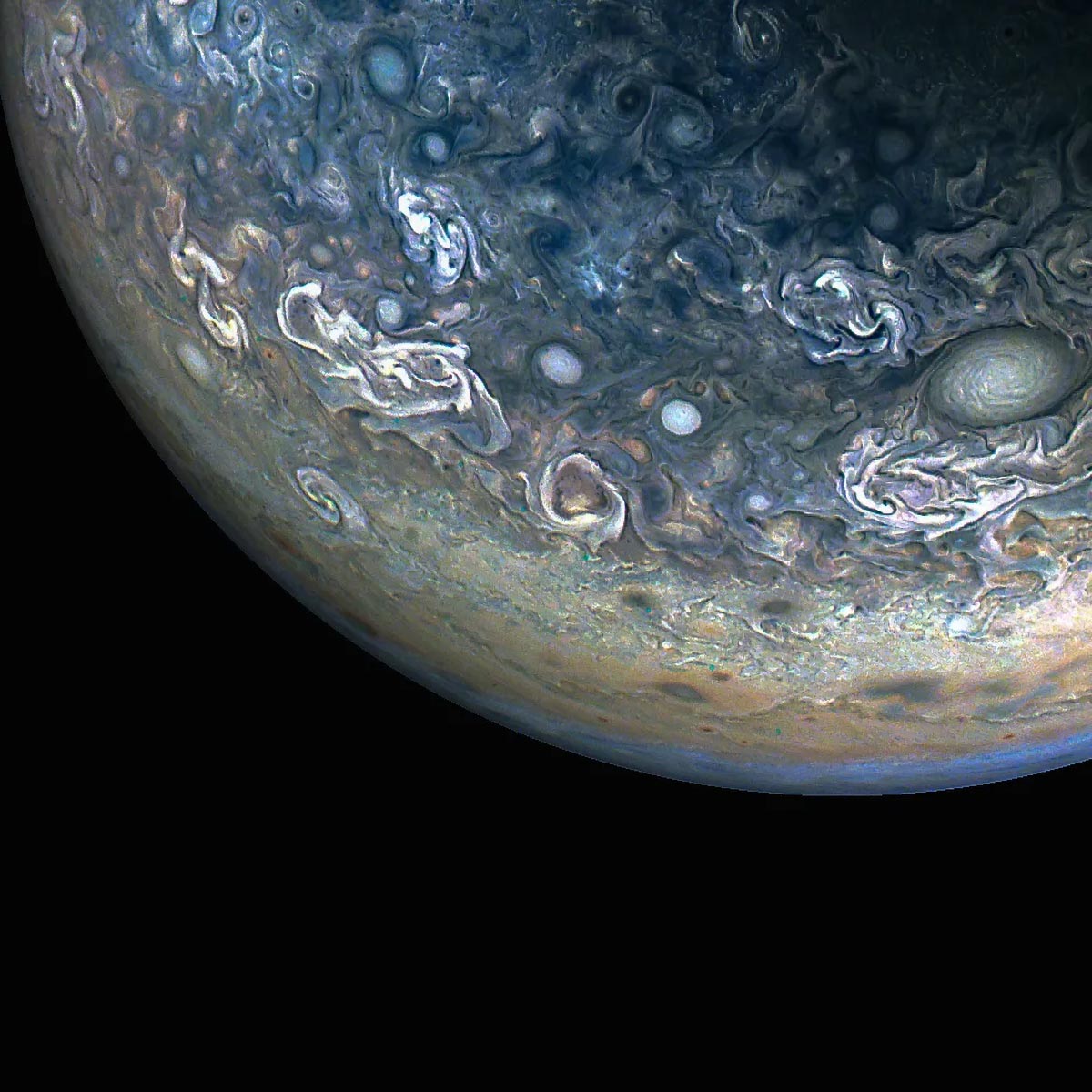
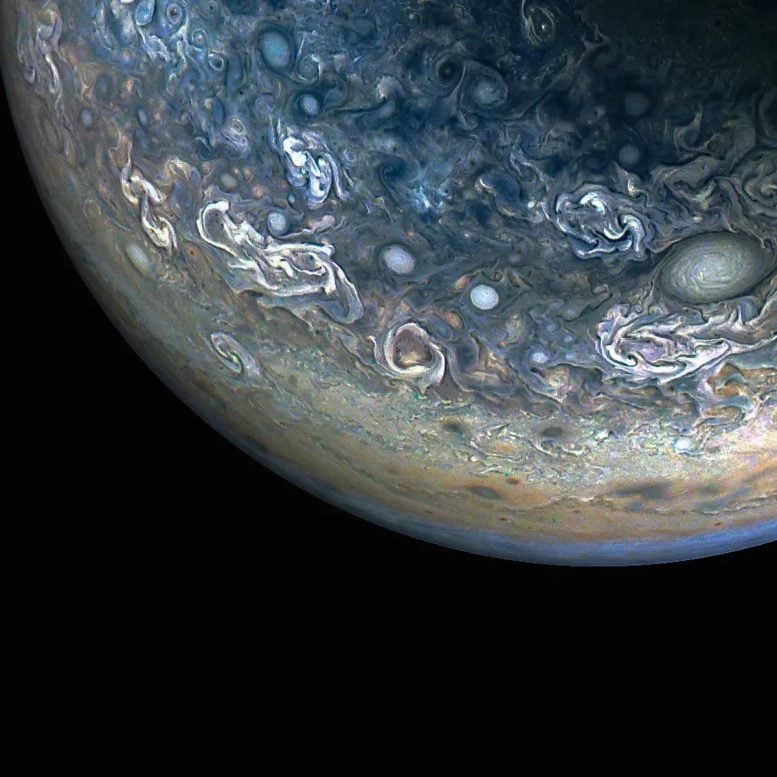
On May 12, 2024, during its 61st flyby of Jupiter, NASA’s Juno spacecraft captured a detailed image of Jupiter’s northern hemisphere, highlighting chaotic cloud formations and cyclonic storms. Image credit: NASA/JPL-Caltech/Southwest Research Institute/Space Science and Mathematics Program, image processing by Gary Eason © CC BY
During its recent flyby of Jupiter, the Juno spacecraft captured transformative images of Jupiter’s storms and cloud patterns.
During its 61st flyby of Jupiter On May 12, 2024, NASANASA’s Juno spacecraft captured this enhanced-color image of the northern hemisphere of the giant planet. The image provides a detailed view of chaotic clouds and cyclonic storms in an area known to scientists as the folded filamentary region. In these regions, the zonal jets that create the familiar ribbon patterns in Jupiter’s clouds collapse, resulting in turbulent patterns and cloud structures that develop rapidly over just a few days.
Citizen scientist Gary Eason captured this image using raw data from the JunoCam instrument, and applying digital processing techniques to enhance color and clarity.
At the time the raw image was taken, Juno was about 18,000 miles (29,000 kilometers) above Jupiter’s cloud tops, at a latitude of about 68 degrees north of the equator.
Raw images from JunoCam are available to the public for viewing, processing, and conversion into image products at https://missionjuno.swri.edu/junocam/processingMore information about NASA’s citizen science can be found at https://science.nasa.gov/citizenscience And https://www.nasa.gov/solve/opportunities/citizenscience.
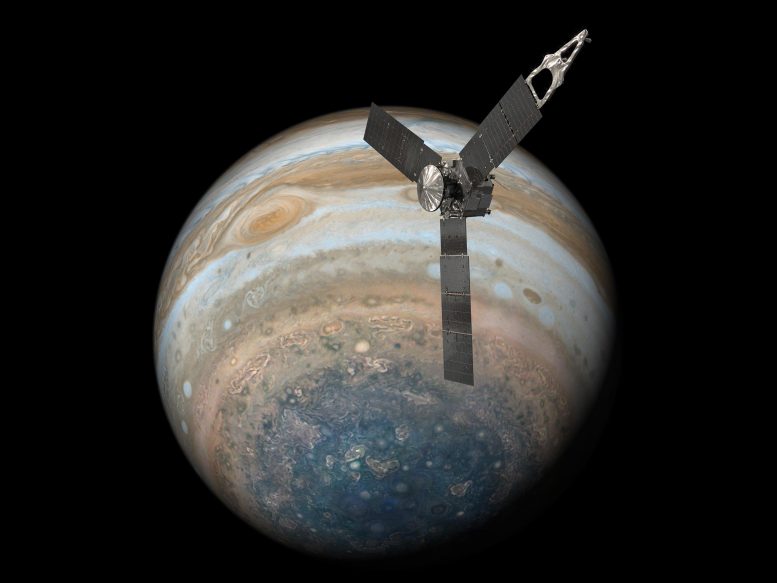
This illustration depicts NASA’s Juno spacecraft flying over Jupiter’s south pole. Image credit: NASA/JPL-Caltech
Juno is a NASA space probe designed to study Jupiter, the largest planet in our solar system. Launched on August 5, 2011, Juno’s mission is to better understand Jupiter’s composition, gravity, magnetic field, and polar magnetosphere. It also aims to search for clues about how the planet formed, which could provide deeper insights into the early days of the solar system.
The spacecraft is part of NASA’s New Horizons program, which explores the solar system through repeated flights of medium-sized spacecraft. Juno is solar-powered, a notable feature because it has operated farther from the Sun than any solar-powered probe before.
Juno entered Jupiter’s orbit on July 4, 2016, and has been making close flybys above the planet’s cloud tops ever since, collecting data. The probe uses a suite of scientific instruments to conduct its investigations, including a microwave radiometer to peer beneath thick cloud cover and an array of cameras and sensors to map the planet’s magnetic and gravitational fields.
Juno’s findings have provided unprecedented images of Jupiter’s atmosphere, revealing complex structures in the planet’s storms, bands, and auroras. Juno’s mission, originally scheduled to end in 2018, has been extended several times, allowing for continued exploration and discovery around Jupiter.