
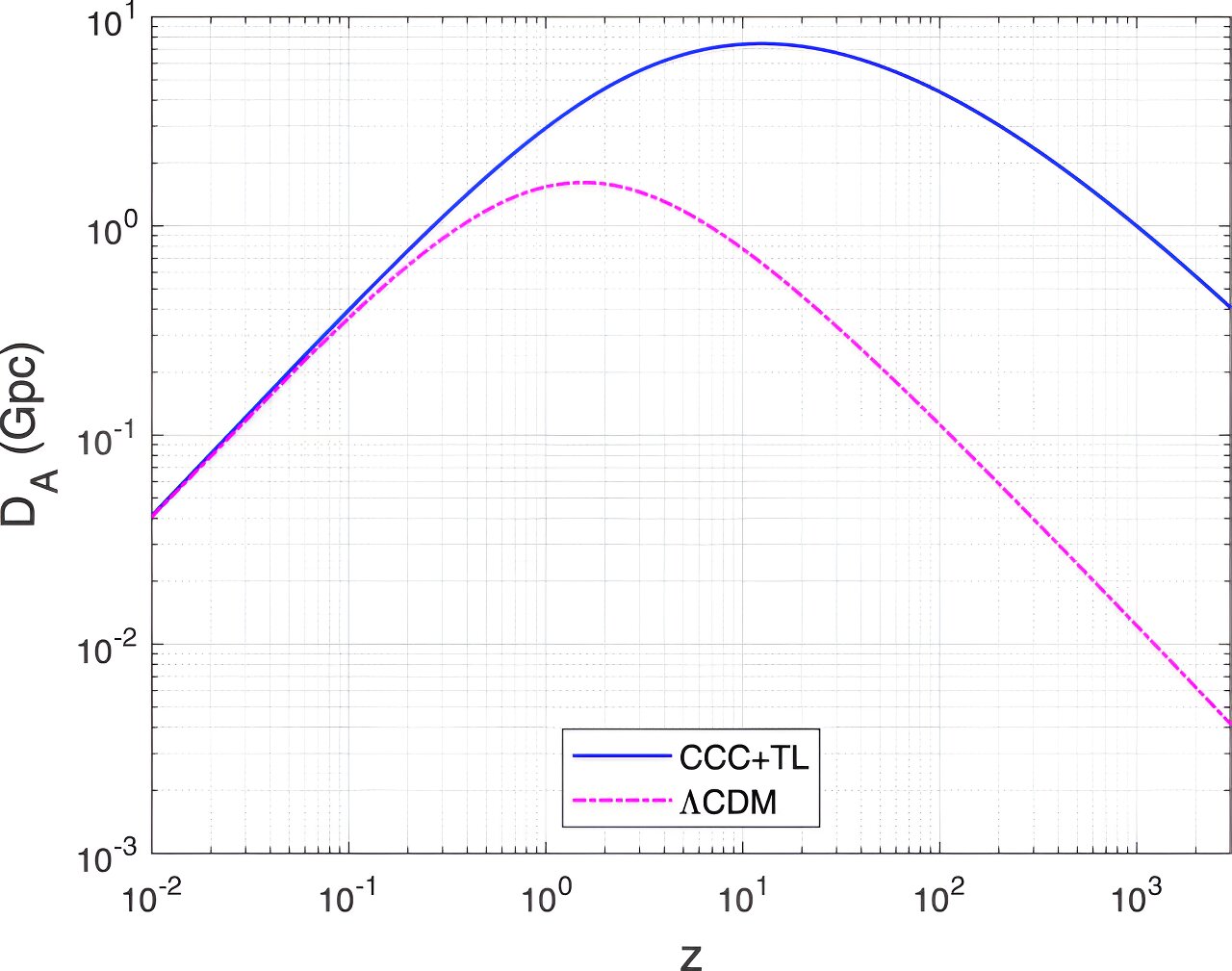
Angular diameter distance as a function of redshift in the CCC+TL and ΛCDM models. credit: Astrophysical Journal (2024). doi: 10.3847/1538-4357/ad1bc6
× Close
Angular diameter distance as a function of redshift in the CCC+TL and ΛCDM models. credit: Astrophysical Journal (2024). doi: 10.3847/1538-4357/ad1bc6
The current theoretical model for the formation of the universe is that it consists of ordinary matter, dark energy and dark matter. A new University of Ottawa study challenges this.
study, published today in Astrophysical JournalIt challenges the current model of the universe by showing that there is actually no room for dark matter.
In cosmology, the term “dark matter” describes anything that does not appear to interact with light or electromagnetic fields, or that can only be explained by the force of gravity. We can't see it, and we don't know what it's made of, but it helps us understand how galaxies, planets, and stars behave.
Rajendra Gupta, a professor of physics in the College of Science, used a combination of variable coupling constants (CCC) and “tired light” (TL) theories (CCC + TL model) to reach this conclusion.
This model combines two ideas: about how the forces of nature decline over cosmic time, and about how light loses energy when it travels a long distance. It has been tested and shown to be consistent with many observations, such as how galaxies spread out and how light evolved from the early universe.
This discovery challenges the prevailing understanding of the universe, which suggests that about 27% of it is made up of dark matter and less than 5% of regular matter, with the remainder being dark energy.
Challenging the need for dark matter in the universe
“The study results confirm that our previous work (“JWST Early Universe Observations and ΛCDM Cosmology”) on the age of the Universe at 26.7 billion years has allowed us to discover that the Universe does not need dark matter to exist,” explains Gupta.
“In standard cosmology, the accelerating expansion of the universe is said to be caused by dark energy but it is actually due to weak forces of nature as it expands, not due to dark energy.”
“Redshifts” refer to the shift of light toward the red part of the spectrum. The researcher analyzed data from recent research on the distribution of galaxies at low redshift and the angular size of the acoustic horizon in the high redshift literature.
“There are many papers that question the existence of dark matter, but my paper is the first, to my knowledge, that rules out its cosmological existence while being consistent with the major cosmological observations that we have had time to confirm,” Gupta says.
By challenging the need for dark matter in the universe and providing evidence for a new cosmological model, this study opens new ways to explore the fundamental properties of the universe.
more information:
Rajendra P. Gupta, Testing CCC+TL cosmology with observed baryonic acoustic oscillation features, Astrophysical Journal (2024). doi: 10.3847/1538-4357/ad1bc6