
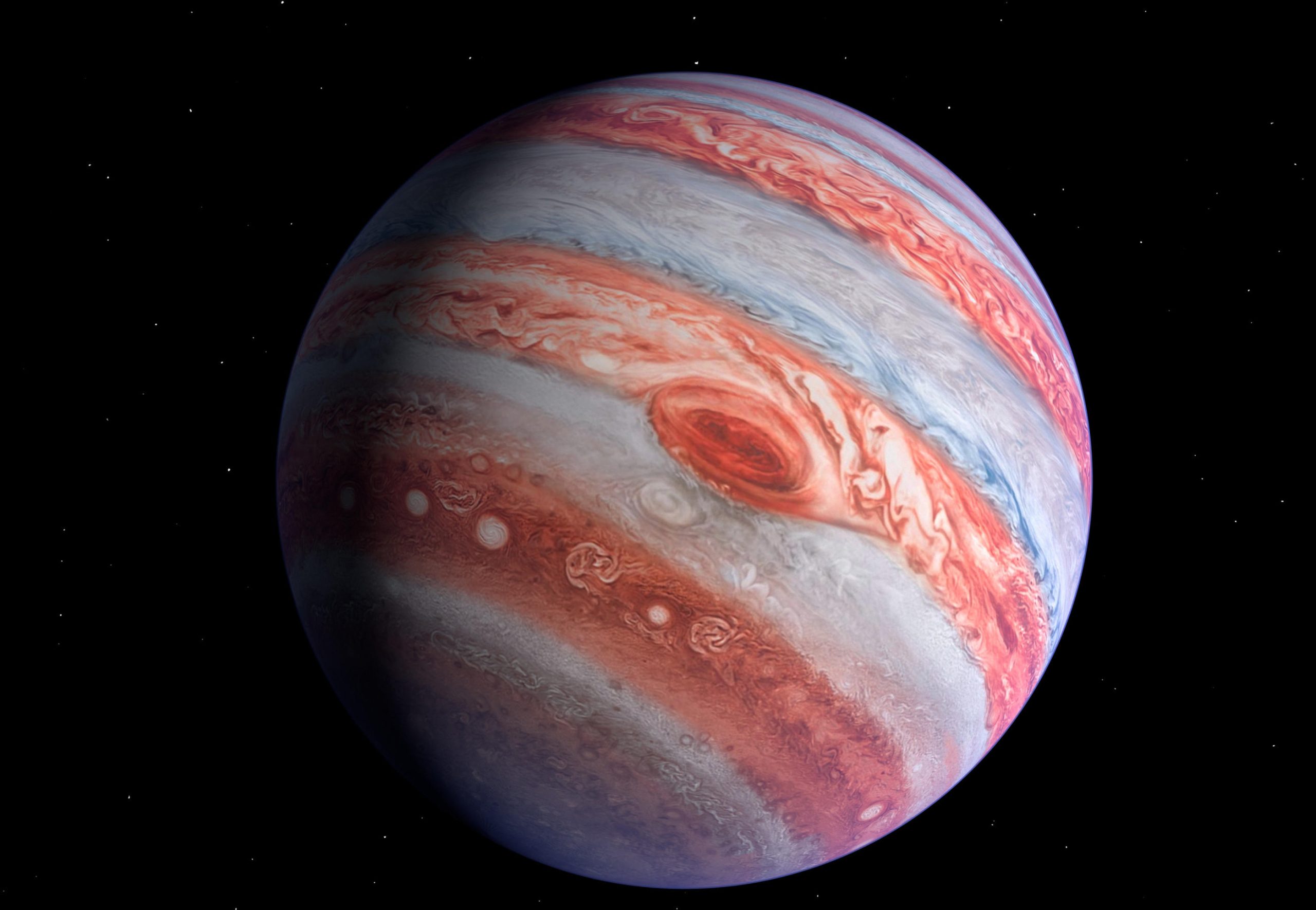

Many of the volatiles on Earth came from outside Jupiter. Credit: Imperial College London/NASA
Imperial College London researchers have discovered the possible distant origin of Earth’s volatile chemicals, some of which are the building blocks of life, by analyzing meteorites.
Researchers found that nearly 50% of Earth’s supply of volatile zinc came from asteroids that originated from the outer solar system, outside the asteroid belt that includes planets such as[{” attribute=””>Jupiter, Saturn, and Uranus. This material is believed to have also supplied other crucial volatiles, such as water.
Volatiles are elements or compounds that easily transition from solid or liquid to a gaseous state at relatively low temperatures. They include the six most frequently occurring elements in living organisms, as well as water. As such, the addition of this material will have been important for the emergence of life on Earth.
Prior to this, researchers thought that most of Earth’s volatiles came from asteroids that formed closer to the Earth. The findings reveal important clues about how Earth came to harbor the special conditions needed to sustain life.

Blue planet: the findings reveal clues about the origin of Earth’s water.
Senior author Professor Mark Rehkämper, of Imperial College London’s Department of Earth Science and Engineering, said: “Our data show that about half of Earth’s zinc inventory was delivered by material from the outer Solar System, beyond the orbit of Jupiter. Based on current models of early Solar System development, this was completely unexpected.”
Previous research suggested that the Earth formed almost exclusively from inner Solar System material, which researchers inferred was the predominant source of Earth’s volatile chemicals. In contrast, the new findings suggest the outer Solar System played a bigger role than previously thought.
Professor Rehkämper added: “This contribution of outer Solar System material played a vital role in establishing the Earth’s inventory of volatile chemicals. It looks as though without the contribution of outer Solar System material, the Earth would have a much lower amount of volatiles than we know it today – making it drier and potentially unable to nourish and sustain life.”
The findings were recently published in Science.
To carry out the study, the researchers examined 18 meteorites of varying origins – eleven from the inner Solar System, known as non-carbonaceous meteorites, and seven from the outer Solar System, known as carbonaceous meteorites.

We’re now closer to understanding the Earth’s unique abundance of life-sustaining water.
For each meteorite they measured the relative abundances of the five different forms – or isotopes – of zinc. They then compared each isotopic fingerprint with Earth samples to estimate how much each of these materials contributed to the Earth’s zinc inventory. The results suggest that while the Earth only incorporated about ten percent of its mass from carbonaceous bodies, this material supplied about half of Earth’s zinc.
The researchers say that material with a high concentration of zinc and other volatile constituents is also likely to be relatively abundant in water, giving clues about the origin of Earth’s water.
First author on the paper Rayssa Martins, PhD candidate at the Department of Earth Science and Engineering, said: “We’ve long known that some carbonaceous material was added to the Earth, but our findings suggest that this material played a key role in establishing our budget of volatile elements, some of which are essential for life to flourish.”
Next, the researchers will analyze rocks from Mars, which harbored water 4.1 to 3 billion years ago before drying up, and the Moon. Professor Rehkämper said: “The widely held theory is that the Moon formed when a huge asteroid smashed into an embryonic Earth about 4.5 billion years ago. Analyzing zinc isotopes in moon rocks will help us to test this hypothesis and determine whether the colliding asteroid played an important part in delivering volatiles, including water, to the Earth.”
Reference: “Nucleosynthetic isotope anomalies of zinc in meteorites constrain the origin of Earth’s volatiles” by Rayssa Martins, Sven Kuthning, Barry J. Coles, Katharina Kreissig and Mark Rehkämper, 26 January 2023, Science.
DOI: 10.1126/science.abn1021
The study was funded by the Science and Technology Facilities Council (STFC – part of UKRI) and Rayssa Martins is funded by an Imperial College London Presidents’ Ph.D. Scholarship.