
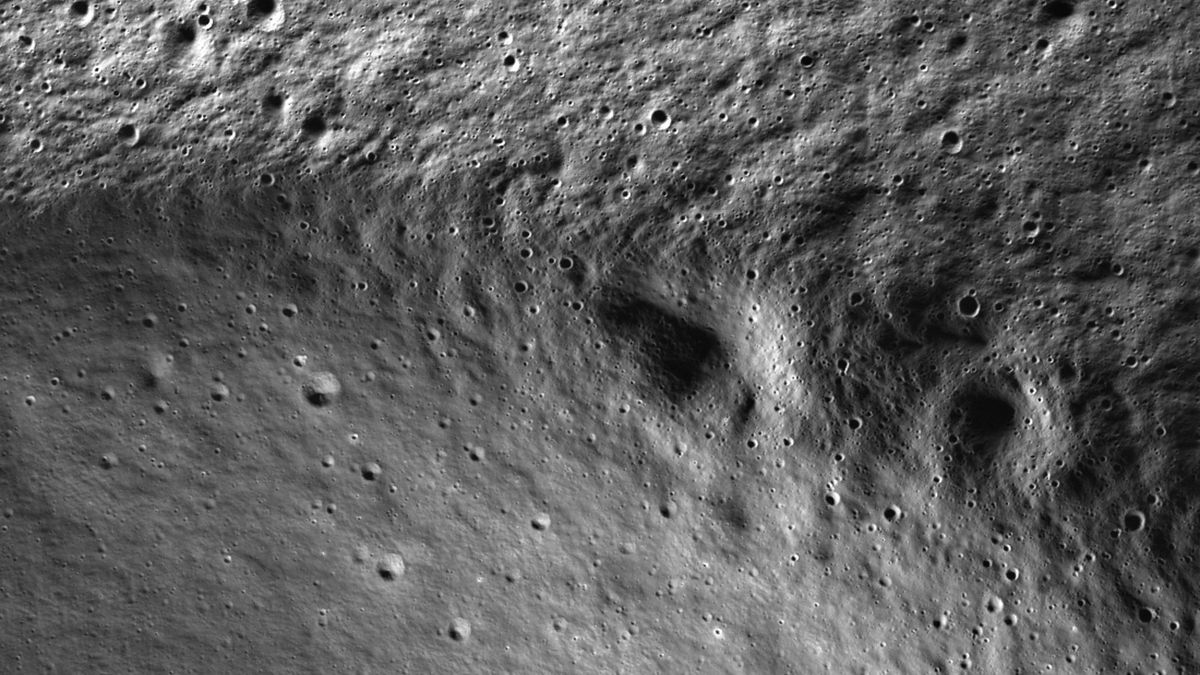
NASA has imaged the lunar south pole in stunning detail as scientists learn as much as possible about the shadowy region before the Artemis 3 mission carries astronauts there in the near future.
The images were collected by a highly sensitive optical camera operated by NASA called ShadowCam. The instrument is being carried around the moon by the Korean spacecraft Pathfinder Lunar Orbiter (KPLO), also known as Danuri, built by the Korea Aerospace Research Institute (KARI). The vehicle, also carrying five Korean science instruments, launched in August 2022 atop a SpaceX Falcon 9 rocket and entered lunar orbit the following December when ShadowCam began imaging the moon.
ShadowCam is ideal for high-resolution imaging of areas of the Moon that do not receive direct sunlight because it is more sensitive to light than other lunar cameras. By taking images of the heavily shaded regions of the Moon’s south pole, ShadowCam is laying the groundwork for Artemis 3 and future robotic missions.
Related: NASA’s Artemis 3 mission: landing humans on the moon
One feature that the camera was able to image in greater detail than ever before is the wall and floor of Shackleton Crater, located near the moon’s south pole.
ShadowCam peered into the steep crater 13 miles (21 kilometers) wide and 2.6 miles (4.2 kilometers) deep to see the path created when a boulder rolled down its slope. Such observations can help determine the characteristics of the rocks in the area and the shapes and velocities of the rocks that make up the tracks.

Even with ShadowCam’s amazing imaging ability, this instrument still needs help examining some of the deeply shadowed craters on the Moon. One of the sources it could use is the “earthshine” light reflected from our planet’s moon.
Although sunlight shining directly on the Moon is still ten times brighter than the illumination provided by Earth’s brightness, light from Earth still helps the camera test ShadowCam’s sensitivity in the Moon’s equatorial region.

Earthshine allowed scientists to image the interior of Bruce Crater located at the Moon’s equator. ShadowCam was able to see the luminous streams formed from the soil sliding down the walls of the crater.
The central peak of Aristarchus Crater was also captured by ShadowCam using Earthshine as a secondary light source.

There is another type of secondary illumination that ShadowCam can exploit to image regions of the Moon that are deprived of direct sunlight. This depends on the light the Sun reflects off the Moon’s geological features such as the mountains and crater walls at the poles that rise high above the Moon’s surface.

The camera used this technique to take an image of the rim of Marvin Crater, about 16 miles (26 kilometers) from the moon’s south pole. This also showed a wider area around the 2.85-mile (4.6-kilometer) wide crater, part of which was illuminated by direct sunlight. The contrast between the two regions demonstrates the ShadowCam’s sensitivity.

The ShadowCam images follow the successful Artemis 1 flight during which NASA tested equipment that will take astronauts to the moon, including the Space Launch System (SLS) rocket and Orion spacecraft.
The next major test of the Artemis framework will be the Artemis 2 mission which will see the Orion spacecraft ferry its first crew into space. The astronauts named for the Artemis 2 crew are: Commander Reed Wiseman, Pilot Victor Glover, Mission 1 Specialist Christina Hammock Koch, and Mission 2 Specialist Jeremy Hansen. The crew will make a 10-day test trip to the lunar circumference, but will not land on the lunar surface.
When Artemis 3 astronauts finally explore the lunar south pole, including the first woman and first person of color to set foot on the lunar surface, ShadowCam will not be able to image them if they are in direct sunlight as the photos will be. pale The camera may be able to capture astronauts walking on the surface during a lunar night when only Earth’s light illuminates them.
Artemis 2 is expected to launch in late 2024, if all goes according to plan. Artemis 3 will follow next in 2025, based on current timelines.