
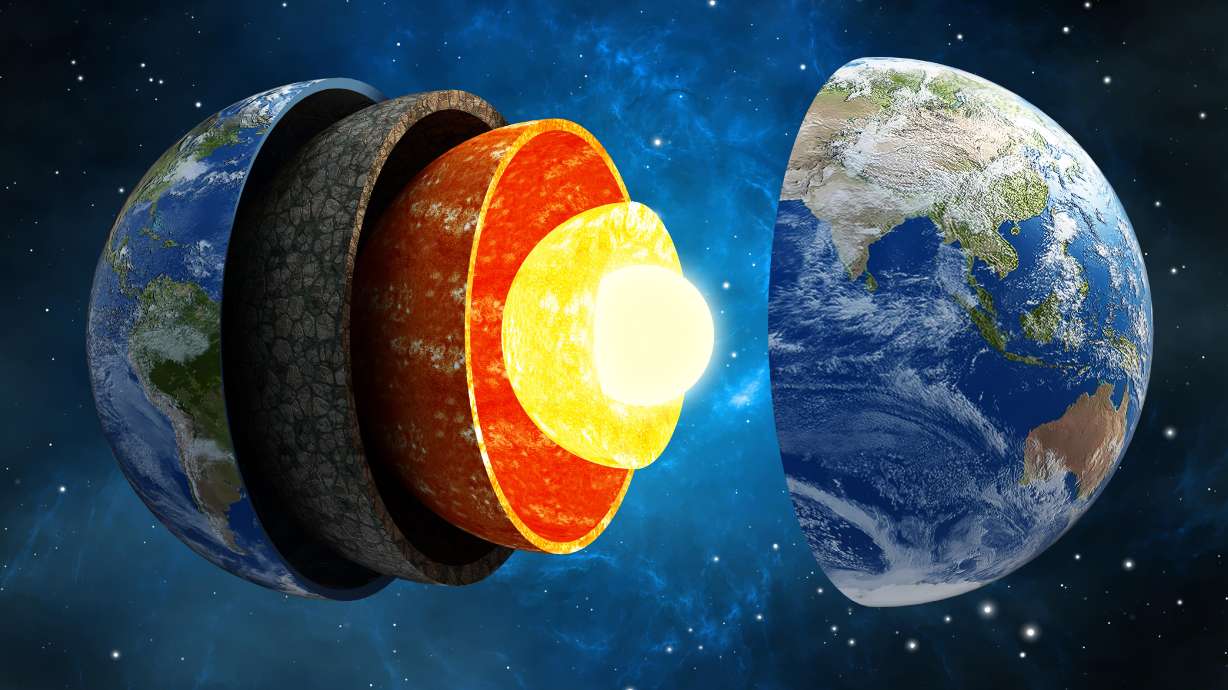
A new study finds that the rotation of Earth’s inner core may have paused and could be heading in the opposite direction. (Sigdem Simsek, Cosmopolitan)
Estimated reading time: 3-4 minutes
ATLANTA — New research has found that the rotation of Earth’s inner core may have paused and could be heading in the opposite direction.
The Earth is made up of the crust, mantle, and inner and outer cores. The solid inner core lies about 3,200 miles below Earth’s crust and is separated from the semi-solid mantle by the liquid outer core, which allows the inner core to rotate at a different speed than the Earth itself rotates.
With a radius of roughly 2,200 miles, Earth’s core is about the size of Mars. It consists mostly of iron and nickel, and contains about a third of Earth’s mass.
In a paper published in the journal Nature Geoscience on Monday, Yi Yang, an associate research scientist at Peking University, and Xiaodong Song, a chair professor at Peking University, studied seismic waves from earthquakes that have passed through the Earth’s inner core along similar trajectories since the 1960s to infer how fast the planet rotates. inner core.
They said what they found was unexpected. Since 2009, seismic records, which previously changed over time, have shown little variation. They said this indicated that the rotation of the inner core had paused.
“We make surprising observations that the inner core has almost stopped spinning in the last decade and may be reversing,” they wrote in the study.
“When you look at the decade between 1980 and 1990, you see obvious change, but when you see 2010 to 2020, you don’t see much change,” Song added.
The rotation of the inner core is driven by the magnetic field generated in the outer core and balanced by the gravitational effects of the mantle. Knowing how the inner core rotates could shed light on how these layers and other processes interact deep within the Earth.
However, the speed of this rotation, and whether it is variable, is up for debate, said Hrvoje Tkalczyk, a geophysicist at the Australian National University who was not involved in the study,
“The inner core doesn’t stop completely,” he said. He said the study’s findings “mean that the inner core is now more in sync with the rest of the planet than it was a decade ago when it was spinning a little faster.”
“Nothing is catastrophic,” he added.
Song and Yang argue that based on their calculations, a small imbalance in the electromagnetic and gravitational forces could slow and even reverse the rotation of the inner core. They believe this is part of a seven-decade cycle, and that the turning point prior to the one they detected in their data for 2009/10 occurred in the early 1970s.
“The data analysis in the study is sound,” said Tkalcik, author of Earth’s Inner Core: Detection of Observed Earthquakes. However, the study’s findings “must be taken with caution” because “more data and innovative methods are needed to shed light on this intriguing problem.”
Song and Yang agreed that more research was needed.
Study of the Earth’s core
Tkalcic, who devotes an entire chapter of his book to the inner core circulation, suggested that the inner core cycle is every 20 to 30 years, instead of the seventy suggested in the last study. He explained why such differences occurred and why it was so difficult to understand what was happening in the inner regions of the planet.
“The objects of our studies are buried thousands of kilometers under our feet,” he said.
He explained, “We use geophysical inference methods to infer internal characteristics of the Earth, and care must be taken for interdisciplinary results to confirm our hypotheses and conceptual frameworks.”
“You can think of seismologists like doctors who study the internal organs of patients’ bodies with imperfect or limited equipment. So, despite progress, our picture of the Earth’s interior is still hazy, and we’re still in the discovery phase.”
Latest science stories
More stories you may be interested in