
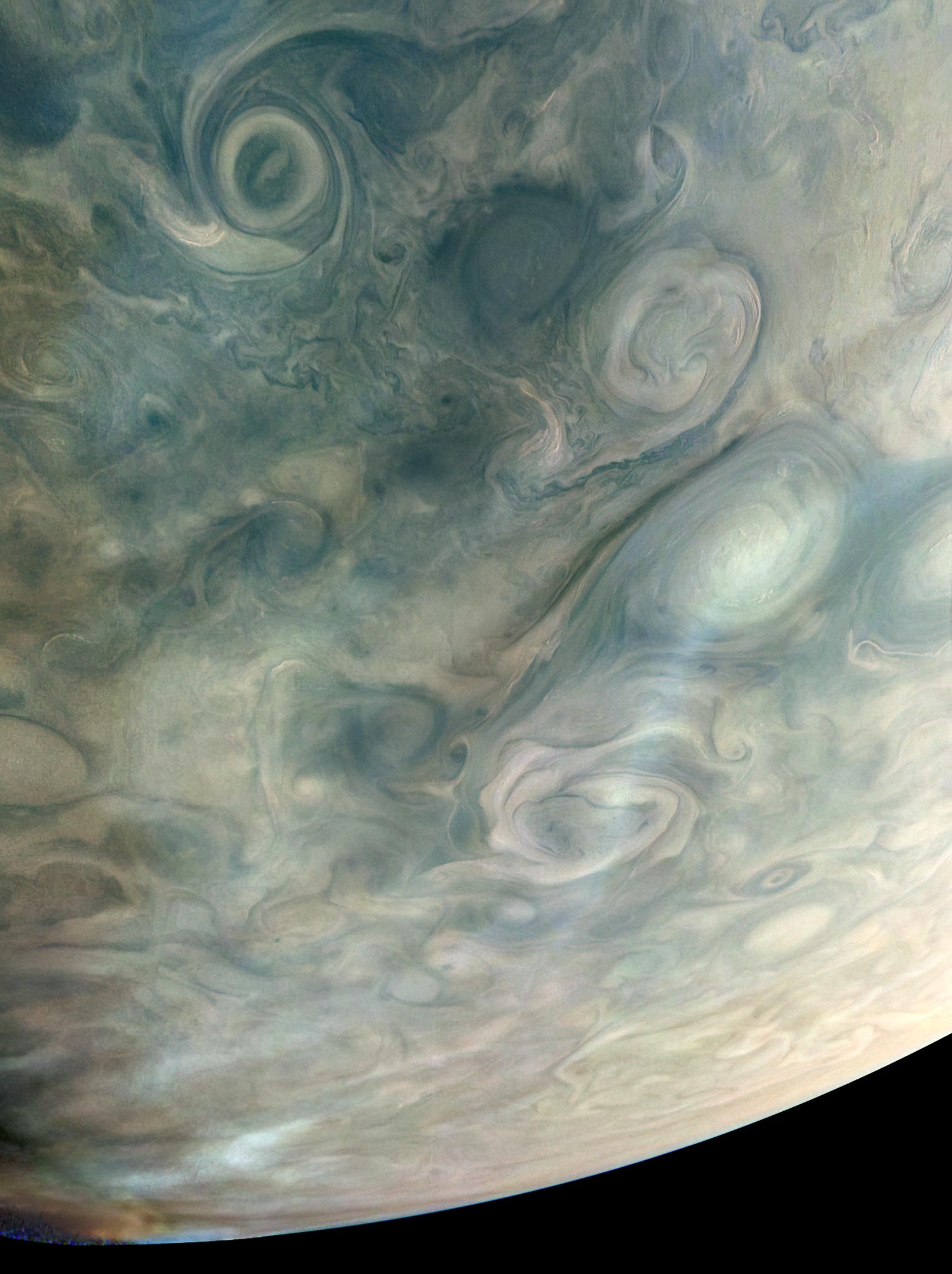
NASA’s Juno mission achieved a significant milestone with the completion of the 49th flyby of Jupiter on March 1, 2023. During its flyby, the spacecraft captured remarkable images of high-altitude haze bands forming over hurricanes in an area referred to as Jet N7. Credit: NASA/JPL-Caltech/SwRI/MSSS, image processing by Björn Jónsson © CC NC SA
On March 1, 2023,[{” attribute=””>NASA’s Juno mission completed its 49th close flyby of Jupiter. As the spacecraft flew low over the giant planet’s cloud tops, its JunoCam instrument captured this look at bands of high-altitude haze forming above cyclones in an area known at Jet N7.
Citizen scientist Björn Jónsson processed a raw image from the JunoCam instrument, enhancing the contrast and sharpness. At the time the image was taken, Juno was about 5,095 miles (8,200 kilometers) above Jupiter’s cloud tops, at a latitude of about 66 degrees.

This photo of Jupiter, taken from the Hubble Space Telescope on June 27, 2019, features the Great Red Spot, a storm the size of Earth that has been raging for hundreds of years. Credit: NASA, ESA, A. Simon (Goddard Space Flight Center), and M.H. Wong (University of California, Berkeley)
Jupiter is the largest planet in our solar system, renowned for its massive size and distinctive bands of swirling, colorful clouds. This gas giant is best recognized for its Great Red Spot, a storm that’s larger than Earth and has been raging for hundreds of years. Jupiter possesses an impressive magnetosphere, creating intense radiation zones and a dramatic influence on its environment.
The planet is surrounded by at least 95 moons, the four largest being Io, Europa, Ganymede, and Callisto—also known as the Galilean moons, named after the astronomer Galileo Galilei who discovered them. These moons each have unique characteristics, from volcanic activity to possible subsurface oceans.

An artist’s concept of the Juno spacecraft in orbit around Jupiter. Credit: NASA
The Juno mission, launched by NASA on August 5, 2011, aims to understand the origin and evolution of Jupiter. This solar-powered spacecraft arrived at Jupiter in July 2016, and its primary mission is to peek beneath Jupiter’s dense cloud cover to study the planet’s atmosphere and magnetosphere. Juno accomplishes this by using a suite of scientific instruments, including the JunoCam, a camera specifically designed to capture high-resolution images of Jupiter’s poles.
The Juno mission also aims to determine whether Jupiter has a solid core, map its magnetic field, measure water and ammonia in the deep atmosphere, and observe the planet’s auroras. Through its extensive flybys, the Juno spacecraft is providing unprecedented insights into Jupiter’s structure, atmosphere, and the fundamental processes that drive its complex system.