
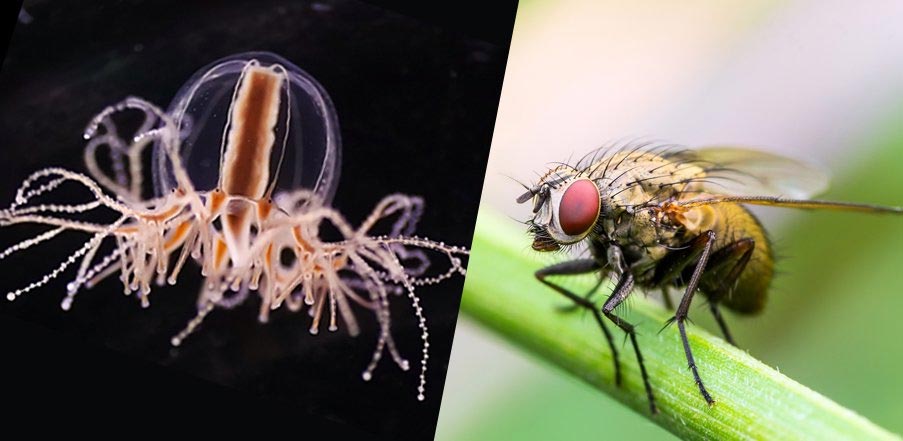
Researchers from Tohoku University Graduate School of Life Sciences have discovered a relationship between neuropeptides that regulate food intake in jellyfish and fruit flies, despite the two being 600 million years apart. The team, led by Hiromu Tanimoto and Vladimiros Toma, found that GLWamide in Cladonema jellyfish and muscle inhibitory peptide (MIP) in fruit flies share structural similarities, suggesting an evolutionary link. When they exchanged these neuropeptides between the two species, the GLWamide/MIP system still functioned effectively in controlling feeding behaviour, highlighting the deep evolutionary origins of the conserved satiety signal.
Researchers have found a relationship between neuropeptides that regulate food intake in jellyfish and fruit flies, despite 600 million years of difference. The GLWamide/MIP system that controls feeding behavior was found to be functionally conserved between the two[{” attribute=””>species, revealing deep evolutionary origins of a conserved satiety signal.
Decades’ worth of research has shown that the motivation to feed, i.e., hunger and feelings of fullness, is controlled by hormones and small proteins called neuropeptides. They are found in a wide array of organisms like humans, mice and fruit flies. Such a widespread occurrence suggests a common evolutionary origin. To explore this phenomenon, a research group has turned to jellyfish and fruit flies, discovering some surprising results.
Although jellyfish shared a common ancestor with mammals at least 600 million years ago, their bodies are simpler; they possess diffused nervous systems called nerve nets, unlike mammals which have more concrete structures such as a brain or ganglia. Still, jellyfish possess a rich repertoire of behaviors, including elaborate foraging strategies, mating rituals, sleep and even learning. Despite their important position in the tree of life, these fascinating creatures remain understudied, and almost nothing is known about how they control their food intake.

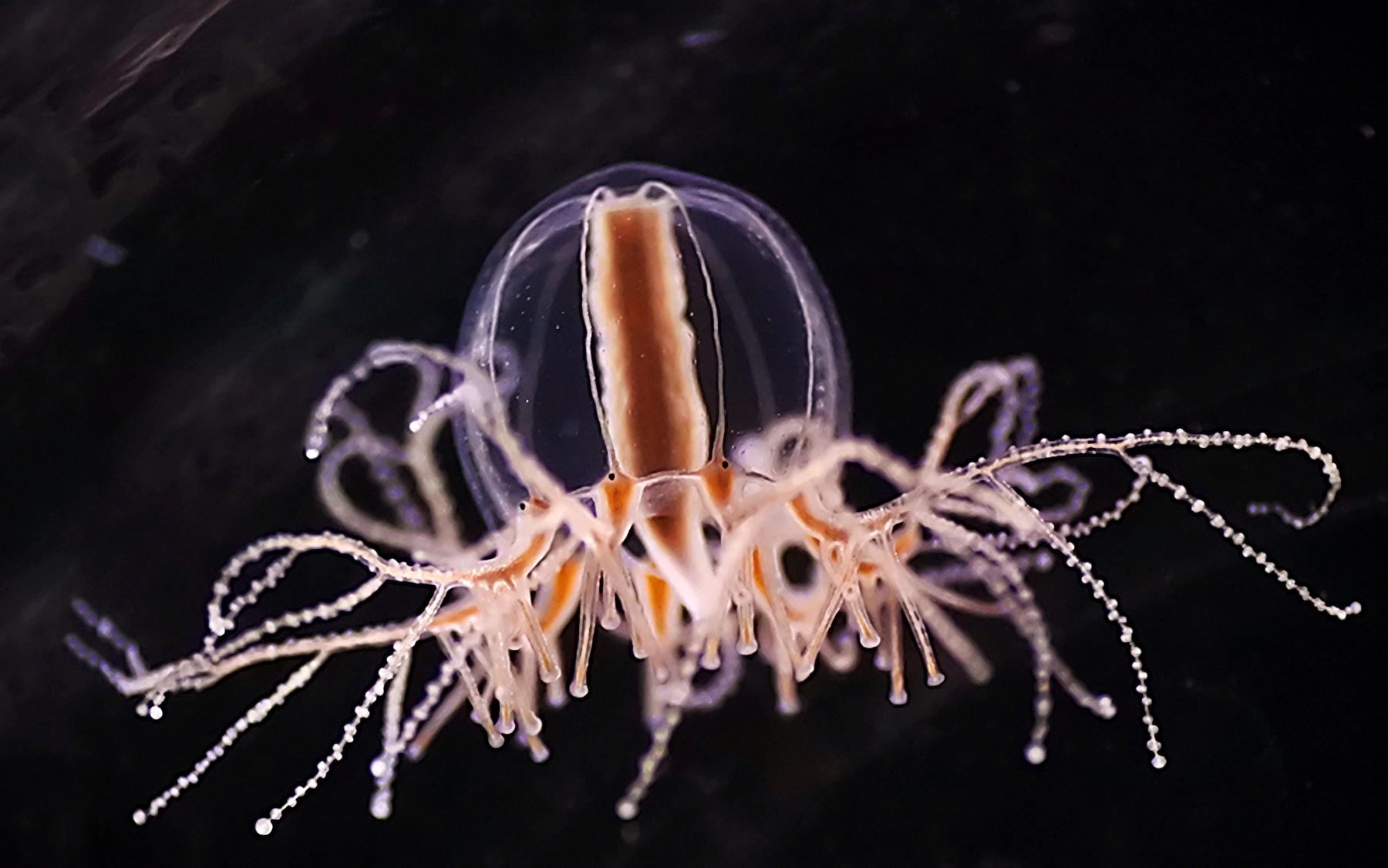
The jellyfish Cladonema pacificum. Credit: Hiromu Tanimoto
The group, which was led by Hiromu Tanimoto and Vladimiros Thoma from Tohoku University’s Graduate School of Life Sciences, focused on Cladonema, a small jellyfish with branched tentacles that can be raised in a laboratory. These jellyfish regulate how much they eat based on how hungry they are.
“First, to understand mechanisms underlying feeding regulation, we compared the gene expression profiles in hungry and fed jellyfish,” said Tanimoto. “The feeding state changed the expression levels of many genes, including some that encode neuropeptides. By synthesizing and testing these neuropeptides, we found five that reduced feeding in hungry jellyfish.”
The researchers then honed in on how one such neuropeptide – GLWamide – controls feeding. A detailed behavioral analysis revealed that GLWamide inhibited tentacle shortening, a crucial step for transferring captured prey to the mouth. When the researchers labelled GLWamide, they found it was present in motor neurons located in the tentacle bases, and feeding increased GLWamide levels. This led to the conclusion that, in Cladonema, GLWamide acts as a satiety signal – a signal sent to the nervous system indicating that the body has had enough food.

The GLWamide (green) expressed in neurons surrounding the Cladonema eyelet (black circle). Nuclei shown in magenta. Credit: Vladimiros Thoma et al.
Yet the researchers’ quest to explore the evolutionary significance of this finding did not stop there. Instead, they looked to other species. Fruit flies’ feeding patterns are regulated by the neuropeptide myoinhibitory peptide (MIP). Fruit flies lacking MIP eat more food, eventually becoming obese. Interestingly, MIP and GLWamide share similarities in their structures, suggesting they are related through evolution.
“Since the functions of GLWamide and MIP have been conserved despite 600 million years of divergence, this led us to ponder whether it was possible to exchange the two,” said Thoma. “And we did exactly that, first giving MIP to jellyfish and then expressing GLWamide in flies that had no MIP.”
Amazingly, MIP reduced Cladonema feeding, just as GLWamide had. Furthermore, the GLWamide in flies eliminated their abnormal over-eating, pointing to the functional conservation of the GLWamide/MIP system in jellyfish and insects.
Tanimoto notes that their research highlights the deep evolutionary origins of a conserved satiety signal and the importance of harnessing a comparative approach. “We hope that our comparative approach will inspire focused investigation of the role of molecules, neurons and circuits in regulating behavior within a wider evolutionary context.”
Reference: “On the origin of appetite: GLWamide in jellyfish represents an ancestral satiety neuropeptide” by Vladimiros Thoma, Shuhei Sakai, Koki Nagata, Yuu Ishii, Shinichiro Maruyama, Ayako Abe, Shu Kondo, Masakado Kawata, Shun Hamada, Ryusaku Deguchi and Hiromu Tanimoto, 3 April 2023, Proceedings of the National Academy of Sciences.
DOI: 10.1073/pnas.2221493120